
Monday, December 19, 2011

Tuesday, December 13, 2011
"For some reason there's always death around us."
 ". . . My parents, my grandfather, my grandmother . . . your real mother, even Eriko. My god - in this gigantic universe there can't be a pair like us. The fact that we're friends is amazing. All this death . . . all this death."
Banana Yoshimoto (1964-) is the pen name of Mahoko Yoshimoto. Her father is the famed poet and critic Takaaki Yoshimoto, while sister Haruno Yoiko is a well-known cartoonist. Yoshimoto describes her favorite motifs as "the exhaustion of young people in contemporary Japan" and "the way in which terrible experiences shape a person's life." Kitchen, her debut novel, was released in 1988 and 1993 in English translation by Megan Backus.
Kitchen actually consists of two works: the novella Kitchen itself and a companion short story called "Moonlight Shadow" featuring different characters but exploring similar themes. In the former, a student named Mikage Sakurai has just lost her grandmother. Already orphaned in early childhood, she finds herself alone in the world until she receives an unexpected invitation. Mikage subsequently moves in with Yuichi and his father, a trans woman named Eriko, and spends several happy months with a new family. Shortly after moving out, however, she hears of Eriko's death at the hands of a stalker and Yuichi's ensuing depression. Kitchen is ultimately a coming-of-age story about the process of overcoming tragedy. For Mikage, this is carried out through the her love of cooking. She had long been fond of kitchens as centers of the home, but has now gained a greater respect for food as both nourishment and a vital aspect of social life. The time and care that go into preparation and the immediate appeal to the senses communicate volumes in a simple, tangible manner. It is through food that Mikage expresses her concern for Yuichi and eventually draws them closer. Kitchen ends on a wiser, hopeful note.
"Moonlight Shadow" centers more on the issue of closure. Satsuki has lost her boyfriend Hitoshi in a car accident that also killed Yumiko, the girlfriend of his brother Hiiragi. Jogging over Hitoshi's favorite bridge one morning Satsuki encounters Urara and is intrigued by both the depth of pain in Urara's face and her promise to show her something wonderful. Unlike Mikage's gradual development, Satsuki's experiences, as befitting the short story format, are revelatory and more immediately transformative. The added element of fate in the meeting between Satsuki and Urara gives the "Moonlight Shadow" a mystical quality that compliments the more down-to-earth feel of Kitchen.
With their straightforward prose and quiet settings, both Kitchen and "Moonlight Shadow" leave an impression of that airiness and precision common to Japanese prose. Unfortunately, Megan Backus's translation reveals the potential only, not Yoshimoto's actual delivery. Not only are her syntax and word choice clunky but several Amazon reviews familiar with the original claim she cut out entire sentences. There are two poignant stories here but they've been underserved. Still, each is short and sweet and easily relatable as expressions of a universal dilemma: how to break the emotional paralysis of grief and continue on.
Banana Yoshimoto's website, including her English journal, may be found here.

Monday, November 28, 2011
Excerpts from Vertical Motion

Translated from Chinese by Karen Gernant and Chen Zeping
Open Letter Books
Because this book of bleak urban surrealism is impossible to explain.
"Vertical Motion"
When we stop digging, we don't move. We're like pupae as we dream in the black earth. We know that our dreams are similar, but our dreams have never been strung together. Each of us has his or her own dreams. During those long dreams, I can bore deep into the earth and fuse into a single body with the earth. In the end, my dreams are about only the earth. Long dreams are great, for they are sheer relaxation. But if this goes on for a long time, I feel vaguely discontented, because a dream of earth can never give me the joy I most want to experience.
After finishing the cigarette, Gu thanked the worker and stood up, intending to continue up the stairs, when he suddenly heard the worker beside him make a cat sound. It was very harsh. But when he glanced at him, he looked as if nothing had happened. No one else was here. If he hadn't made the sound, who had? Gu changed his mind; he wanted to see if this person would do anything else.
He waited awhile longer, but the worker didn't do anything, he just put his cigarette butt in his pocket, rose, and went back to the water cart. He pushed the cart into the ward. Gu subconsciously put his hand into his own pocket, took out the cigarette butt, and looked at it, but he saw nothing unusual. In a trance, he twisted and crushed the butt. He saw an insect with a shell moving around in the tobacco shreds. The lower half of its body had been charred, but it still didn't seem to want to die. Nauseated, Gu threw the butt on the floor and, without looking back, climbed to the eighth floor.
It could be said that I had "turned a blind eye" to this building for years. The granite wall was very old with dark watermarks on it. This was a deserted building. I heard a key turn twice in the lock, and the door opened with a creak. I went inside without a second thought.
A person with his back to me was standing in the empty corridor. In the dim light, I couldn't get a good look at his face. I thought he was crying.
"On the 18th of April, you saw the beginning and the end of the matter," he said, his bare head gleaming and closing in on me. I still couldn't see his face well. I waited for him to go on talking, but he didn't: it was as if something had struck him. Bending over, he began to sob softly.
Wumei told her that the last time she went to the market to sell papercuts, a group of women had surrounded her. They wanted a hundred of her works. Those countrified women seemed to come from a remote mountain area. There were two blind people among them.
"Did they buy your interlinked rings?" asked Mrs. Yun.
"Yes. They wanted to take them home and learn how to make the rings. When I asked them where they came from, they just mentioned a strange place name. It definitely isn't in our province, and yet I could understand their accent. One of the older ones told me that the sun shines there all year long, so they like black and they like circles."
Mrs. Yun took stock of Wumei's bathroom wall. Now there were no longer black rings pasted there, but many yellow ants. Looking at them was nauseating. Wumei was truly spirited and skillful. Such tiny ants: she could cut them out they were so lifelike. But why didn't she cut some pleasant things?

Review Copy
Thursday, November 24, 2011

Tuesday, November 22, 2011
Art
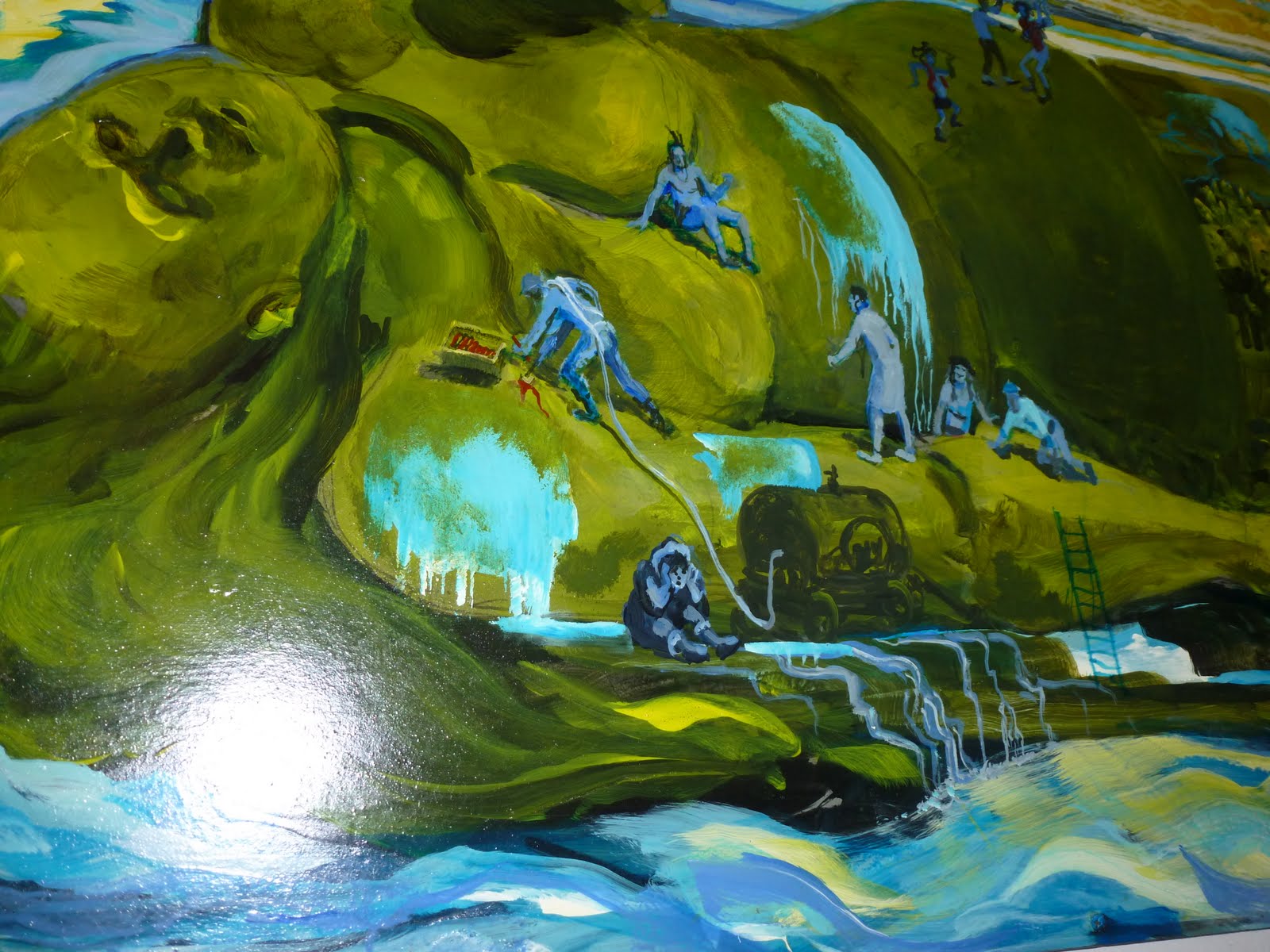
My ~300 square foot studio is full of art. My favorite thing about this city is its vibrant arts scene with its numerous galleries and events, from the outdoor summer festivals to the artisan fairs that pop up every weekend during the holidays. Open year-round are the thrift and antique stores full of unique items at great prices. In addition to the high ceilings, southern exposure, hardwood floors, and old building, the best part of my apartment is art.


Over the dresser. Three original photographs, a woodblock stamp, and a ceramic piece from a funky independent boutique.

An original watercolor from a local Mid-Century Modern antique shop. Over Bookshelf #1.

My grandfather painted this. Leaning against the wall on Bookshelf #2.


My grandfather painted this too.

A pencil sketch of me drawn by a random guy at the coffeehouse in exchange for a hot chocolate.

Authentic original print by Hasui Kawase. Purchased dirt cheap at an antiquarian book fair. Restoring and framing with proper archivist materials was not cheap.

Mounted photo dated 1989, showing an interesting architectural detail from a Russian Orthodox church in Maynard.

Handmade letterpress poster from a festival.

Small piece of cardboard I hand-pressed at a local printing company. Pen and ink sketch from a thrift store.




Tuesday, November 15, 2011
Top 10 7 Unread Books on My Shelf

It's been forever since I've done one of these. This is a particularly interesting topic because I just weeded out a ton of old books from my shelves, mostly college history texts. So I do plan on getting to all of these or else I wouldn't have kept them.
7. Dan Simmons, Ilium
Hey look, it's 700+ pages. I didn't love the Hyperian Cantos THAT much.
6. Banana Yoshimoto, Kitchen
This one's only 152 pages. Really, I have no excuse.
5. Margaret Atwood, The Blind Assassin
I loved Oryx & Crake and got it signed when I saw Atwood at a local college last year. I actually started this but abandoned it for some reason, even though the premise was intriguing.
4. Umberto Eco, The Name of the Rose
I've seen him live too, along with Salman Rushdie. Unlike Atwood, who was very humorous and engaging, Rushdie and Eco were so dull I actually don't remember anything they said or did. But still, I've heard many great things about this book.
3. Thomas Mann, Doctor Faustus
2. Thomas Mann, The Magic Mountain
I love Thomas Mann. I've read many short stories by both him, as well as novellas by his contemporary Hermann Hesse and yet I still can't bring myself to crack open either of these two thick tomes. I'll get to them eventually, I promise - I even spared them my recent Book Purge. Someday.
1. John Dos Passos, Manhattan Transfer
Srsly, WTF. This book has everything I love - experimental Modernism, New York City, the early twentieth century - and I've read The 42nd Parallel twice. And this has been on my shelf for, what, two years now???
Top Ten Tuesday is an original feature/weekly meme created at The Broke and the Bookish. This meme was created because we are particularly fond of lists at The Broke and the Bookish. We'd love to share our lists with other bookish folks and would LOVE to see your top ten lists! Each week we will post a new Top Ten list complete with one of our bloggers' answers. Everyone is welcome to join. If you don't have a blog, just post your answers as a comment. Don't worry if you can't come up with ten every time . . . just post what you can!
Friday, November 11, 2011
"the question of occupation."
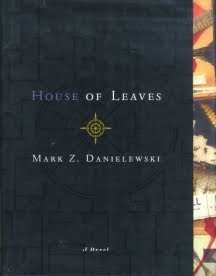 Though few will ever agree on the meaning of the configurations or the absence of style in that place, no one has yet to disagree that the labyrinth is still a house. Therefore the question soon arises whether or not it is someone's house. Though if so whose? Whose was it or even whose is it? Thus giving voice to another suspicion: could the owner still be there? - An excerpt from The Navidson Record
Anyone who understands this work in its entirety understands, in its entirety, Neon Genesis Evangelion. (This is a law, not an assertion.) Thus, House of Leaves is Evangelion-complete. - TVTropes.org
Mark Z. Danielewski (1966-) is the son of Polish avant-garde film director Ted Danielewski and the brother of singer-songwriter Annie Decatur Danielewski, better known as Poe. He has a graduate degree from the USC School of Cinema-Television and has worked on sound for the documentary Derrida. House of Leaves, his 2000 debut novel, combines his interests in film and experimental art and has attracted a considerable cult following. Poe's second album Haunted was released simultaneously as a companion work.
House of Leaves is a dual novel following two distinct stories. Framing the work is the first-hand account of Johnny Truant, an apprentice tattoo artist in LA with a freewheeling life of sex, drugs, and hard Hollywood partying. His friend Lude invites him to the apartment of a recently deceased neighbor known only as Zampanò. A blind, solitary man who nevertheless unnerved the building's Herculean superintendent, Zampanò turns out to have been an imaginative and prolific writer who left behind a strange manuscript called The Navidson Record. Truant sets out to edit the many scattered leaves, some scribbled on the most unlikely of places such as the backs of stamps and envelopes, only to find that the thing is consuming him, sending him on a downward spiral of madness and paranoia. There is a monster afoot, lurking just out of the corner of his eye when he looks up from the pages, hiding in those hidden pockets without sound. It's always there. Concentrate on these words. Don't let your eyes leave the page.
The Navidson Record is a scholarly work discussing the titular film by photojournalist Will Navidson. Will, his girlfriend Karen Green, and their two children Chad and Daisy, age eight and five, have left New York City for an old farmhouse in rural Virginia. Will and Karen hope to repair their relationship, which has become strained due to his sudden, frequent, and often dangerous overseas assignments. To make the most of his new downtime, Will seeks to combine his craft and new circumstances in a film that will follow his family's adjustment to life in the country. But The Navidson Record is not the film he set out to make. Imagine returning from vacation to find a closet where there wasn't a closet before. The house, they learn, is bigger on the inside than on the outside. And it can get even bigger. In the miles of corridors and winding staircases, perpetually shrinking and expanding, something growls.
Beyond that, hell if I know.
Others more qualified than I have tried to explain this labyrinth of a book, where the text changes color and position and the footnotes frequently overwhelm the narrative. It is obviously, first and foremost, a postmodern work of psychological horror that explores the interaction between humans and the spaces we inhabit. Zampanò's imaginary scholarly sources interrogate Will Navidson's film from every angle imaginable, offering interpretations of the house that range from the Freudian to the pop cultural to the theological. The source of the growl is offered up as either the sound of the house shifting - similar to the groans of the Arctic ice that haunted stranded explorers - or a
It should be noted, however, that Zampanò's body was found besides a series of strange, deep gorges in the floor.
The book is Mind Screw like that. Like I said, hell if I know.

Mark Z. Danielewski's House of Leaves was The Wolves' reading selection for October. (This post was very late.) Please feel free to join us for the rest! You can find the complete book list here.
Subscribe to:
Comments (Atom)


 Posts
Posts


