Showing posts with label Historical Fiction. Show all posts

Friday, February 24, 2012

"When I began carrying Henrik in my womb, I was afraid, but I decided to cease fearing."

The Brothers
By Asko Sahlberg
Translated from Finnish by Emily Jeremiah and Fleur Jeremiah
122 pages
Peirene Press
February 2012


. . . I sensed that motherhood was terrible, perhaps sweet at times, but above all terrible. Not because one human child would be more horrendous than another, nor is it so that offspring cannot bring joy when little and be useful when grown up, but because motherhood makes it possible for future generations to be rocked by dark tragedies. (46)

Asko Sahlberg (1964-) is one of Finland's most famous living authors. He published his first novel in 2000 and has received numerous awards. He currently lives in Sweden.

Published in 2010, He (The Brothers, translated by mother-daughter team Emily and Fleur Jeremiah) is Sahlberg's ninth work. Henrik and Erik are two brothers born to an old family of Finnish landowners. While Erik stayed behind, the restless and ambitious Henrik fled to the glittering cities of Russia to be seduced by the wealth and power of empire. In the Russo-Swedish War of 1788-1790 he fought for Russia, while Erik enlisted himself and his downtrodden cousin Mauri to fight for Sweden. It is now 1809 and Henrik has returned to the old farmstead, instigating a chain of events that threaten to expose long-buried secrets and finally upend an unstable status quo.

The story is told through several first-person narrators, including not only Erik and Henrik but also their mother, Erik's wife Anna, Mauri, an old farmhand, and occasional one-shots such as a maid and a city bureaucrat. Peirene publisher Meike Ziervogel compares it to As I Lay Dying and it is easy to see why. One of my English professors described Faulkner's novel as Cubist, with each of the narrators reflecting a different facet of the story, akin to a Picasso painting revealing all angles at once. In The Brothers this form allows the various secrets to be revealed to the reader but not the other characters, allowing for an omniscient view and numerous twists. I was also reminded of Chekhov's play The Cherry Orchard, with its faded aristocrats forced from their traditional complacency where they least expect it. Altogether, the combination of a slowly unfolding plot and dark but subdued prose is a tightly-wound tale whose intensity is in its brevity. Recommended.

Review Copy

Sunday, October 2, 2011

"I perceived differently my relations with the divine."

I could see myself as seconding the deity in his effort to give form and order to a world, to develop and multiply its convolutions, extensions, complexities. I was one of the spokes of the wheel, an aspect of that unique force caught up in the multiplicity of things; I was eagle and bull, man and swan, phallus and brain all together, Proteus who is also Jupiter. (146)

Marguerite Yourcenar (1903-1987) was a Belgian-born French novelist and essayist. In 1980 she became the first woman elected to the Académie française. She published her first novel Alexis in 1929 and moved to the United States a decade later to escape the outbreak of World War II. Mémoires d'Hadrien was published in 1951 to great critical acclaim.

Memoirs of Hadrian, translated from French by Grace Frick in collaboration with Yourcenar, is a fictionalized autobiography of the Roman Emperor Hadrian, who ruled from 117 to 138. He was one of the Five Good Emperors praised by Niccolò Machiavelli. Edward Gibbon, in his famous work The History of the Decline and Fall of the Roman Empire, characterized their rule as an era when "the Roman Empire was governed by absolute power, under the guidance of wisdom and virtue." Hadrian did in fact write an autobiography but it has since been lost. Yourcenar portrays him as the quintessential "enlightened despot": a deep thinker and well-rounded, experienced statesman who directed his power toward the public good.

At times he seems almost too perfect, but such is probably in keeping with his personality as he composes the history of his own life. Hadrian's appreciation for the highest gifts of civilization - art, philosophy, rule of law - combines with breathtaking prose to recreate an Elysium that reigned briefly before the Dark Ages. The lost world of the Roman elite is one of palatial villas on the shores of the Mediterranean, deeds of daring on the barbarian frontier, and the ancient cults of Egypt and the Near East. Hadrian's conception of divinity extends from his secular knowledge, imagining the gods as innately connected to the various facets of human life. He is especially enamored of beauty in all of its forms, from poetry to soaring architecture to the vitality of youth. The climax of his story is the early death of his lover Antinous by suicide, although for all his rhapsodizing it appears that Hadrian loved him physically but not quite as a full individual. Antinuos was a Tadzio who manifested an ideal or exalted concept. Hadrian had him deified after his death, a megalomaniacal move that nevertheless transcends mere egotism and becomes poetry itself - an epic tale of love lost and the death of beauty in full bloom.

The breadth of Hadrian's lifetime, extending from far-off battles and travels to the depth of his learning, gave Marguerite Yourcenar a large canvas with which to work. She takes maximum advantage of the material offered to her and the result is a brilliant book and homage to what was seen centuries afterwards as one of the Golden Ages of Western civilization. A fascinating and rewarding read.

Shop Indie Bookstores


Marguerite Yourcenar's Memoirs of Hadrian was The Wolves' reading selection for September. Please feel free to join us for the rest! You can find the complete book list here.

Tuesday, August 30, 2011

"I kept wishing Snooky had come back to teach at Kahana. . ."

I'd go to talk to him. He was the only guy who helped you to see things as they were out there. The others ignored your questions or what they saw out there, or tried to make you see only the things they wanted you to see. He talked of freedom, while everybody else talked of duty and obligation.


Milton Muryama (1923-) was born in Hawaii to Japanese immigrants. When he was 12 his family moved to a sugar plantation at Pu'ukoli'i, a company town that no longer exists. His writings later drew much inspiration from there, including 1975's All I Asking for is My Body. Muryama received his B.A. from the University of Hawai'i in English and philosophy in 1947, followed by a master's in Chinese and Japanese from Columbia in 1950.

All I Asking for is My Body follows the life of Kiyo from fourth grade to his entry into the armed forces to fight on the European front in World War II. His father is an unsuccessful fisherman turned plantation worker and his mother sews kimonos. Despite their hard work, the family struggles to get by, with an inherited debt of $6,000 hanging over their heads. As Kiyo grows older, the proverbial "East-West" divide is increasingly pronounced and emphasized by the explosive outbursts of his older brother, Toshio. Their parents stress filial piety, obedience to rank, and social harmony, while mainstream culture promises personal independence. The subsequent dilemma is familiar to anyone who has read other works by second-generation Americans such as Anzia Yezierska, who, like Toshio, struggled violently against what she perceived as the limitations imposed upon her by the customs of the Old Country.
She was acting too damn haolified [white/American]. Whenever anyone spoke goody-good English outside of school, we razzed them. "You think you haole, eh?" "Maybe you think you shit ice cream, eh?" Lots of them talked nasally to hide the pidgin accent. At the same time the radio and haole newspapers were saying over and over, "Be American. Speak English." Pidgin was foreign. And whenever there was a debate about statehood for Hawaii over the radio, they always came back to the same question, "What about the Japanese and Japanese-Americans? They're foreign, their language and culture are foreign, they can't be assimilated, they can't even speak English after eight years of grade school. What if there's a war with Japan? Whom will the AJA's fight for?" Of the 350,000 people in Hawaii, 150,000 were Japanese.
Pointing out elsewhere that practically the only options for educated Japanese-Americans were as teachers or small business owners, Muryama also brings to light an issue glossed over by Yezierska, a Jewish Russian-American. While she would have faced oppression as a Jew, an Eastern European, and a woman, she has passing privileges and would eventually have white privilege as well (see Matthew Frye Jacobson's Whiteness of a Different Color). A person of color does not, and will always be seen as an outsider, particularly if one is of East Asian descent. Ronald Takaki, another Japanese-American from Hawaii, opens A Different Mirror: A History of Multicultural America with an account of a taxi driver who complimented him on his English and asked where he was from. Takaki's family has been in the United States for almost a century.

The issues of heritage and assimilation faced by ethnic/non-white Americans, particularly recent arrivals, are evident in Murayama's very title. All I Asking for is My Body is pidgin English spoken by the Japanese- and Filipino-American sugar plantation workers. As Kiyo explains, he and his friends speak three languages: Japanese at home, "goody-good" English at school, and pidgin for casual conversation. As with Their Eyes Were Watching God, the narrative voice is standard English which contrasts sharply with the dialogue, a disparity argued by Henry Louis Gates to represent a psychological fragmentation similar to W.E.B. Du Bois's ideas of the double-consciousness. As the narrator in this case is Kiyo - as opposed to Hurston's omniscient third person - his colloquial voice renders the divide more organic and less jarring. In fact, it seems to be a synthesis of sorts. All I Asking actually won Muryama praise for his skillful use of pidgin in a manner that was still understandable to a general readership. Kiyo can be said to represent someone who holds the possibility of success, even in a country that Others his body. The ending of All I Asking for is a hopeful one that promises new beginning.

Though not well received when it was initially published, All I Asking for is My Body received critical acclaim when reissued in 1988 and went on to win that year's American Book Award. A prequel called Five Years on a Rock came out in 1994. Unlike Anzia Yezierksa's overwrought drama, All I Asking for unfolds organically and offers a fascinating portrayal of daily life on a Hawaiian sugar plantation in the 1930s. Makes for a great companion to I Hotel.

Shop Indie Bookstores

Monday, August 8, 2011

"My posting to China has taught me what greatness and what misery a soldier can know:"

. . . on orders he moves from one place to the next without knowing where he is going or why. A pawn among many others. He lives and dies anonymously in the name of a greater victory. The game of go is changing me into a senior officer who uses his men coldly and with calculation: the stones make their steady progress, many condemned to die for the sake of a wider strategy.

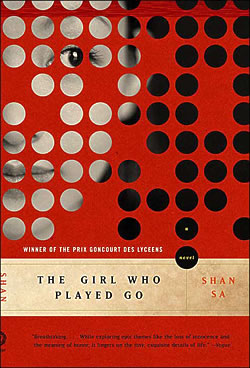
Shan Sa (1972-) was born in Beijing. She moved to Paris in 1990 and studied art for two years under the painter Balthus. Her debut novel Les quatre vies du saule won the Prix Goncourt du Premier Roman in 1998, which was followed by the 2001 Prix Goncourt des Lycéens for La Joueuse de Go (The Girl Who Played Go). Sa is also a painter who has exhibited in Paris, New York, and Shanghai.

The Girl Who Played Go (translated from French by Adriana Hunter) is a star-crossed love story set in occupied Manchuria in the late 1930s. Its voices alternate between two nameless protagonists born worlds apart but destined to collide in a cruel gesture of fate. The first is a Chinese schoolgirl from a worldly but faded aristocratic family. Nearing her sixteenth birthday, her typical teenaged pastimes take a dangerous edge as her newfound sexuality pulls her into a love triangle with two resistance fighters. The second is a Japanese soldier in his early twenties whose relentless focus on honor and national glory is turning him into a war criminal. In an effort to flush out underground "terrorist" cells, the soldier's Captain has ordered him to pose as a Chinese civilian and infiltrate the go square, which the Captain believes is "just a camouflage: it's there on that square, as they pretend to play their war game, that our enemies are putting together their twisted strategies." Both narrators are skilled at this ancient contest of will and intellect and commence a long, drawn-out game that has them seeing one another with greater frequency, even as the situation around them steadily worsens.

Sa is one of those rare authors able to speak volumes with deft, sparse prose. Every word is chosen carefully with none wasted on extraneous exposition or flowery description. Her unflinching portrayal of war cuts like a razor. Most writers would have turned this scenario into a treacly (and not to mention offensive) BRING ME TOOO LIIIIIIIFE story of a Darth Vader type who "still has good in him" and the Love of a Virtuous Woman. Sa brings us instead a pair of complex and often unsympathetic characters whose relationship is never anything grander than two strangers making hesitant contact. Indeed, the love story is actually secondary to the war itself in fitting with the game of go as a metaphor for the insignificance of the individual in life-and-death struggles for conquest and freedom. Sa sacrifices none of her realism to starry-eyed fantasy and the ending is inevitable from the beginning.

The Girl Who Played Go is a powerful work. Though not marketed as YA, older teens will relate to the girl's adolescent struggle for self-realization, which, along with the Marxist idealism of the Chinese resistance, foreshadows the upheavals of Maoism and its attacks on tradition. In fact, she is one of the strongest and most memorable female protagonists I have come across in some time. Her male counterpart is no cardboard cutout either. His chapters reveal a growing dissonance between his patriotic values and the brutalities regularly committed by his comrades. The Girl Who Played Go is a study in contrasts: the dehumanization of war revealed through a highly intimate look into the hearts and minds of two individuals. Highly recommended.

Trigger warning for sexual violence and a graphic torture scene.

Note on the translation: This is the second French novel translated by Adriana Hunter I have read and once again, her work is flawless. The first was Véronique Olmi's Beside the Sea, another dark story that will haunt its reader afterward. I will definitely keep my eye out for more Hunter translations in the future.

Shop Indie Bookstores

Wednesday, February 9, 2011

"Consider these wonders. . ."

"You're drinking with Yasin. Your father's a shameless old man. What's genuine and what's not? Is there any relationship between reality and what's in our heads? What value does history have? What connection is there between the beloved Aïda and the pregnant Aïda? Why did you suffer this savage pain from which you've yet to recover? Laugh till you're exhausted."


Such are the reflections of young Kamal, the emerging Modernist of Cairo's Abd al-Jawad family whose idealistic spirit differentiates him, for a time, from the rest of his drama-ridden family. Yes, EPIC DRAMZ and MOAR EPIC DRAMZ. These people have Issues.

Palace of Desire has the misfortune of being Book #2 in a trilogy, which is never an easy position. Neither beginning nor end, Book #2 is essentially a bridge between them, continuing with characters and situations from the previous volume but being unable to properly conclude anything, as that is the job of Book #3. In this case, we have already established that the al-Jawad family is dysfunctional in many ways. The only thing for Palace of Desire to do is chronicle how the DRAMZ evolves as the characters age and Egyptian society continues to change in the 1920s.

Perhaps "evolves" is the wrong word. Taking place after the cataclysmic events of Palace Walk, the present feels like a lull. A few conversations between Kamal and his friends is all we hear of Egypt's political situation. Instead, the entire focus of Palace of Desire is the petty goings-on and generally idiotic behavior of the adult family members. Father Al-Sayyid Ahmad takes a young lute player as his mistress, dumps her, and Yavin proceeds to marry her after having an affair with her mother. Khadija seems to do nothing but start pointless quarrels with her mother-in-law. Kamal, the smartest and most levelheaded of the bunch, spends entire chapters rhapsodizing about the neo-Platonic perfection of his beloved Aïda. Really, the book could have lost about 200 pages.

I'm not quite sure what the point of all this is. Unless Mahouz intends to go out with a bang, in which case this is like the eye of the storm or. . . Wait, we have some guests here.

Greetings and rise up my fellow workers! As you may recall, I am Karega and this is Joe.

Hi!

What is the meaning of this? You are interrupting a review of the book in which I, Al-Sayyid Ahmad, occupy the central role! And who's this?

I am Reb Smolinsky. The whole world would be in thick darkness if not for men like me who give their lives to spread the light of the Holy Torah. Respect me, impious goy!

WHAT?! Who are you people?! . . . Oh, by the light of heaven, what happened to you???

OY VEY!

Oh that. I had a date with a shell. But don't worry! The Necronomicon has given me some real nifty powers. You oughta see this trick Ephraim Waite taught me.

I would hesitate to anger him, if I were you. Unless you wish to learn for yourself the horrors of the living prison you see before you, a terrible tragedy loosed upon this innocent young man by the corrupt forces of this so-called "democracy." But I digress. Joe and I have been sent here to bestow upon two deserving men the opportunity of a lifetime. Such upstanding pillars of the community as yourselves have truly earned no less.

You honor and illumine me. May God be generous to you, my good man!

I seize good luck by the horns! See how God rewards such years of learning as mine!

I'll tell it to you straight: Karega and I know of an organization in need of a good religious scholar. One of their primary texts is in Arabic so you Al-Sayyid Ahmad can help Reb Smolinsky out. And trust me the pay's real good. We're talking solid gold here.

At last! The riches shine from me! I am a person among people! Oh, see how God is good to a poor man of the Torah!

I find myself intrigued. Do go on.

Few men will ever get this chance. Our clients are highly selective and insist on a few simple preliminary measures before we can proceed.

Nothing to it. Just a few oaths. Basically you just swear to be loyal and keep your mouth shut. In exchange you get some American beachfront property and all the damn gold you want.

Joyful am I! To God I sing my praises! Two simple oaths I take. Yes, I swear my secrecy and loyalty.

Well, now, this is simpler than bedding a singer in the entertainment district. You have my word on both oaths as well.

But there's more! I hear you fellows have been on the lookout for some female companionship.

I have been advised by my physician to embark upon a more sedate life. However, I find myself unable to comply with such demands, as I am a young man yet!

Yes, yes, a new wife I need! A poor widowed scholar I am! For my study I need a good cook and a keeper of the house who does not nag or curse me out to the streets. I need a servant to support my holy labors. You give me this too? Oh glory! I get a good job and gold and now I help a woman get into Heaven. As the good Torah says, women can get into Heaven only because they are the wives and daughters of men.

That makes perfect sense, now that I think of it. Don't forget the other . . . services they provide us as well. Yes, indeed, women truly exist to make men glad.

All it requires is another oath that you will marry one their women and sire her children. With all this gold, Al-Sayyid-Ahmad, you can more than afford to maintain a second wife. Amina won't like it, but who cares about her opinion, right?

She told me herself that she has no opinions of her own. A most excellent wife she is!

How I envy you! Perhaps I will have such a wife as well.

So we're all on board here? Third oaths all around?

Yes!

Yes!

Ph'nglui mglw'nafh Cthulhu R'lyeh wgah'nagl fhtagn.

Wha. . .?

. . .

Congratulations Al-Sayyid Ahmad and Reb Smolinsky! The Esoteric Order of Dagon greatly appreciates the work you will be doing as scholar and translator of the Necronomicon. And you're sure to love Innsmouth. It's quite a charming little place with plenty of fixer-uppers and lovely ocean views. Good luck!

Iä, Iä Cthulhu! Iä, Iä Dagon!

HELP! HELP!

NOOOOOOOOOOOOOO!

Yep. These women aren't going to put up with any of their shit that's for sure.

I have to say I rather do feel sorry for them . . . NOT.


The Cairo Trilogy read-along is being hosted by Richard of Caravana de Recuerdos. Our schedule is:

December 26-27, 2010: Palace Walk
January 30-31, 2011: Palace of Desire
February 27-28, 2011: Sugar Street

Tuesday, December 28, 2010

"He alone would set their course for them, not the revolution, the times, or the rest of humanity."

She did not understand how her heart could answer this appeal, how her eyes could look beyond the limits of what was allowed, or how she could consider the adventure possible and even tempting, no - irresistible. . . Deep inside her, imprisoned currents yearning for release responded to this call in the same way that eager, aggressive instincts answer the call for a war proclaimed to be in defense of freedom and peace.

Naguib Mahfouz (1911-2006) was an Egyptian writer and winner of the 1988 Nobel Prize for Literature. Published as بين القصرين or Bayn al-Qasrayn in 1956, Palace Walk (translated from Arabic by William M. Hutchins and Olive E. Kenny) is the first volume of his seminal Cairo Trilogy that follows the lives and fortunes of three generations of the al-Jawad family from 1919 to 1944. The trilogy is set among the streets of Mahfouz's childhood and, like many of his works, is deeply concerned with the political and social history of Egypt in the twentieth century.

Al-Sayyid Ahmad Abd al-Jawad, an affluent merchant, is known to his friends as a generous and jovial womanizer with a large capacity for alcohol. At home, however, he rules his family as a stern patriarch in the most conservative Muslim tradition. His wife, timid Amina, accepts his authority without question, despite her literal imprisonment in the home even as al-Sayyid Ahmad spends night after night carousing on the town. Yasin, age twenty-two, is his son by a previous marriage that ended in divorce after Yasin's mother refused to submit to him. His four children by Amina are Khadija (20), plain-faced but sharp-tongued; Fahmy (19), a bright and serious law student; Aisha (16), a blond beauty; and Kamal (10), who is playful and mischievous. Much of the story is concerned with the family's day-to-day domestic doings, from the marriages of the daughters to Al-Sayyid Ahmad's active social life and many lovers. But as Egypt begins to increasingly agitate for independence from Great Britain and English soldiers appear in the streets, events start precipitously downhill to a final, disastrous climax.

Richard's post made an observance so obvious I nearly headdesked. I was thinking and thinking of how to link the family's private lives to the tumult of the outside world. I instinctively grasped the connection but Palace Walk is such a large book with so much going on that I wasn't sure where to begin. It turns out that the extreme male privilege that characterizes the al-Jawad household could also mirror the oppression of Egypt as a whole under British imperialism. To that I would add the weight of tradition, which also grants Al-Sayyid Ahmad almost complete control over the lives of his adult sons, including whether or not they marry or divorce or participate in the independence movement. The personalities of Amina and Al-Sayyid Ahmad, meanwhile, are warped to a pathological extent. Amina is the very definition of a doormat, even assuring her husband at one point that, "My opinion is the same as yours, sir. I have no opinion of my own." And the two sides of Al-Sayyid Ahmad are so divergent it's a wonder they co-exist in the same individual.

Both the sons and daughters strain under their father's repressive rule, yet it's the women who stand out more because their situation is so over-the-top. When Fahmy asks his father about marrying a neighboring girl, and when a friend of his asks for Aisha, Al-Sayyid Ahmad's immediate reaction in both cases in OMG HAS HE ACTUALLY SEEN HER OMG OUR HONOR! It's Handmaid's Tale-level patriarchy, only not made up. Holy Taliban.


The general impression is that these women have never known anything different. But there is something subtle lurking, in contrast to an otherwise exposition-heavy book. There is a scene with Amina on her rooftop garden at the very beginning that stayed with me throughout the rest of the story.
The roof, with its inhabitants of chickens and pigeons and its arbor garden, was her beautiful, beloved world and her favorite place for relaxation out of the whole universe, about which she knew nothing. As usual at this hour, she set about caring for it. . . Then for a long time, with smiling lips and dreamy eyes, she enjoyed the scene surrounding her. She went to the end of the garden and stood behind the interwoven, coiling vines, to gaze out through the openings at the limitless space around her.

She was awed by the minarets which shot up, making a profound impression on her. Some were near enough for her to see their lamps and crescent distinctly, like those of Qala'un and Barquq. Others appeared to her as complete wholes, lacking details, like the minarets of the mosques of al-Husayn, al-Ghuri, and al-Azhar. Still other minarets were at the far horizon and seemed phantoms, like those of the Citadel and Rifa'i mosques. She turned her face toward them with devotion, fascination, thanksgiving, and hope. Her spirit soared over their tops, as close as possible to the heavens. Then her eyes would fix on the minaret of the mosque al-Husayn, the dearest one to her because of her love for its namesake. She looked at it affectionately, and her yearnings mingled with the sorrow that pervaded her every time she remembered she was not allowed to visit the son of the Prophet of God's daughter, even though she lived only minutes from his shrine.

She sighed audibly and broke the spell. She began to amuse herself by looking at the roofs and streets. The yearnings would not leave her. She turned her back to the wall. Looking at the unknown had overwhelmed her: both what is unknown to most people, the invisible spirit world, and the unknown with respect to her in particular, Cairo, even the adjacent neighborhood, from which voices reached her. What could this world of which she saw nothing but the roofs and minarets be like? A quarter of a century had passed while she was confined to this house, leaving it only on infrequent occasions to visit her mother in al-Khurunfush. Her husband escorted her on each visit in a carriage, because he could not bear for anyone to see his wife, either alone or accompanied by him.
Note that her moment of imaginative freedom begins in the context of her religion (a safe place) and moves gradually from spiritual to living transcendence (from safety to the outright forbidden). Nor is her name mentioned for the rest of the chapter, as though Amina now stands for a universal Egyptian "she" looking out through the screens and walls of suffocating custom and, just for a moment, stretching her mind (the only part of anyone that's ever truly free) to encompass something more. I was reminded very strongly of a similar, famous scene in Jane Eyre:
Anybody may blame me who likes, when I add further, that, now and then, when I took a walk by myself on the grounds, when I went down to the gates and looked through them along the road; or when . . . I climbed the three staircases, raised the trap-door of the attic, and having reached the leads, looked out afar over sequestered field and hill, and along dim sky-line: that I longed for a power of vision which might overpass that limit, which might reach the busy world, towns, regions full of life I had heard of but never seen: that then I desired more of practical experience than I possessed; more of intercourse with my kind, of acquaintance with variety of character, than was here within my reach. I valued what was good in Mrs Fairfax, and what was good in Adèle; but I believed in the existence of other and more vivid kinds of goodness, and what I believed in I wished to behold. . .

It is vain to say human beings out to be satisfied with tranquillity: they must have action: and they will make it if they cannot find it. Millions are condemned to a stiller doom than mine, and millions are in silent revolt against their lot. Nobody knows how many rebellions ferment in the masses of life which people earth. Women are supposed to be very calm generally: but women feel just as men feel: they need exercise for their faculties and a field for their efforts as much as their brothers do; they suffer from too rigid a restraint, too absolute a stagnation, precisely as men would suffer; and it is narrow-minded in their more privileged fellow-creatures to say that they ought to confine themselves to making puddings and knitting stockings, to playing on the piano and embroidering bags. It is thoughtless to condemn them, or laugh at them, if they seek to do more or learn more than custom has pronounced necessary for their sex.
Virginia Woolf, in A Room of One's Own, sees this passage, with its sudden break to the crazed laugh of Grace Poole, as indicative of a defect in women writers of the time arising from society's refusal to allow them the full range of human experience. "[Charlotte Brontë] will write in a rage where she should write calmly. She will write foolishly where she should write wisely. She will write of herself where she should write of her characters. She is at war with her lot." Amina's passage likewise cuts off abruptly with the reassurance that she is "neither resentful or discontented, quite the opposite." Much as I disagree with Woolf's characterization of Brontë's "deformed and twisted" writing (I think she was overreaching to prove her own point), you can also make an analogous observation of Amina's character, which seems increasingly Stepford Smiler-ish as Palace Walk progresses. Emily's post makes frequent comparisons to the domestic dynamics of Jane Austen (whom I've never read) and discusses how women contribute to their own oppression. Amina later becomes the harshest critic of Yasin's poor wife, Zaynab, who was only married to him after he was caught trying to rape Umm Hanafi the black maid and his father decided it was time he got some legitimate release.

(Umm Hanafi is basically, in American terms, a mammy: a middle-aged black woman with no family of her own who spends her entire life raising and caring for the light-skinned ruling class. When Yasin later tries to rape Nur, another black maid who waits on Zaynab, it's hard not to picture the white plantation son forcing himself on one of his African-American slaves. Now granted, Umm Hanafi is actually, you known, allowed to leave the house, but this also signifies that she is not afforded the "protection" given to wealthy Arab women. Author Kola Boof, who is of Egyptian Arab and black Sudanese descent, writes about race relations today in Africa and the Middle East here and here.)

I saw the women's situation as only one aspect of a society on the brink of some major upheaval. Even the male-dominated push for Egyptian independence involves head-on confrontation with traditional figures, right down to Fahmy's defiance of his father. There are some real undercurrents here and it will be interesting to see how they play out in Palace of Desire and Sugar Street. Al-Sayyid Ahmad is already conservative even by the standards of his day. The encroachment of modernity on his pious household should be interesting, to say the least.

In terms of its prose, Palace Walk differs quite a bit from 1967's Miramar in its more formal tone and emphasis on exposition. Mahfouz both shows and tells to an equal extent. I'm not sure how to describe it exactly - both narrative voice and dialogue have a sort of stiff, timeless quality to them that lacks any distinct voice or realist spontaneity. Almost awkward at times despite a few wonderful passages. Reading the first half would have been a chore if I wasn't fascinated (and repelled) by the portrayal of a foreign culture. The last part is carried entirely by the mounting intensity of the political climate but for 498 pages overall, I can definitely see some readers giving up or skipping ahead (there were some areas where I just skimmed). I have to admit that a thousand more pages of the al-Jawad family is pretty daunting, but I'm all for it.


The Cairo Trilogy read-along is being hosted by Richard of Caravana de Recuerdos. Our schedule is:

December 26-27, 2010: Palace Walk
January 30-31, 2011: Palace of Desire
February 27-28, 2011: Sugar Street

Monday, December 6, 2010

"Swords and axes. Whips and daggers. Give me liberty or give me death!"

I Hotel
By Karen Tei Yamashita
604 pages
Coffee House Press
May 2010


But use your imagination to what end? What's the point of this circus of Siamese twins fathered by a hapless outlaw? Come to America, and your children all come out hyphenated. Half this-half that. Nothing whole. Everything half-assed. And it's more complicated than that. One half trying to be the other half and vice versa. As they say, duking out the dialectics. Working through schizophrenia and assimilation. Poor man. These kids drive him nuts. He's taught them everything they know, but still they have no respect. They think they're supposed to be free in Asian America.


Karen Tei Yamashita, an instructor at the University of California-Santa Cruz, was born in California and has lived in Brazil and Japan. Her fifth novel, I Hotel, is an ambitious endeavor that brings to life the multifaceted creativity and activism of San Francisco's Asian-American communities during one of the most tumultuous decades in living American memory.

I Hotel is actually a compendium of ten novellas for each year between 1968 and 1977, all loosely connected to one another by the presence of the International Hotel. As Yamashita explains in her Afterward, the "I-Hotel," by the time of its demolition '77, was the crumbling home of elderly Chinese and Filipino men who had arrived in America decades earlier bursting with ambition, only to be thwarted by antimiscengenation laws, restrictive acts against Asian immigration, and the prevailing racism of the day. Perhaps due to its symbolic significance, the I-Hotel became the epicenter of the Yellow Power movement that took inspiration from the Black Panthers, global Marxism, and the period's explosion of civil rights movements. Yellow Power was diverse and decentralized, embracing political revolution, social justice, economic empowerment, and radical scholarship. Most activists did not know what their compatriots were doing, Yamashita found, and I Hotel is a suitably sprawling canvas nevertheless united by its characters' shared passion for change and the ever-present International Hotel.

I-Hotel is in many ways comparable to John Dos Passos's The 42nd Parallel, as a multi-media chronicle of various individual Americans as they negotiate their era's trends and dynamics. The stories of assorted Chinese-, Japanese-, and Filipino-Americans – from their respective positions as students, professors, artists, filmmakers, poets, musicians, laborers, and community organizers – are revealed through lists, comics, plays, free verse, interviews, photos, audiovisual transcripts, flights of magic realism, mythology, and fragments of real-life quotes and documents interspersed throughout several of the narratives. The result is a panoramic, ground-level tour-de-force that gradually coalesces into something greater than the sum of its parts.
When it's all said and done, you might have a compilation of events, and you might have a story with meaning. Someone says, don't worry about the details, just get the story. Someone else says, get the details and the hard facts, and then you can build a case for a story. Someone says a good story might help you remember, but someone else says that everyone remembers differently. Everyone's got a version of the same story, or maybe there's no such thing as the same story; it's a different story every time.
The characters are different yet representative. The first novella focuses on a refined Chinese scholar, his youthful protégés, and their friend the Filipino cook, as well as the contradictions of Maoist China and its relationship to the Asian-American Left. The third, "'I' Hotel," centers on a conversation between a Black Panther and a member of the Red Guard Party in a Moscow hotel room. In "Int'l Hotel," three Japanese-American youths accompany a Modoc Indian to Alcatraz Island during the 1969 occupation, while a Chinese-American dancer dreams of uniting Peking Opera with avant-garde jazz to tell a story of life, identity, and history in "Aiiieeeee! Hotel."

For all their utopian hopes, however, the disparity between belief and reality seems to all but promise eventual disillusionment. Nevertheless, the legacy of Yellow Power is a broad one, says Yamashita, and includes Asian-American studies, law cooperatives, historians, educators, works of art and music, underground cooperatives, and drug rehabilitation programs. Furthermore, since many forms of oppression overlap (called "intersectionality" by sociologists), numerous activists also fought on other battlegrounds, such as feminism and disability rights.

Despite its size, I Hotel surges ahead quickly, its versatile storytelling preventing it from ever dragging or getting old. Part novel, part history text, Karen Tei Yamashita's brilliant, well-written, and well-researched achievement is the go-to book for anyone interested in Asian-American history, radical politics in America, the turbulent sixties, and grassroots activism. General readers, meanwhile, will have their eyes opened, a fact to which this reviewer can personally attest.


Review Copy


Wednesday, August 25, 2010

"hospitable and harsh, beautiful and uncanny city"

Portrait of the Mother as a Young Woman
By Friedrich Christian Delius
Translated from German by Jamie Bulloch
125 pages
Peirene Press
September 2010


          after every confinement there was space, after every darkness, light, after every emergency, help, but it was uncomfortable and exhausting and involved much sacrifice to obtain light and salvation, redemption and beatitude, that was more or less the meaning of this verse, everything was good, everything was in God's hands, and the more solid people were in this belief, the less they would be troubled by questions and anxieties, the more calmly they could wander down dark streets such as this, . . . (72-73)

Friedrich Christian Delius was born in 1943 in Rome, the eldest of four siblings. He began contributing to his school and local papers in 1961 and published his first book of poetry, Kerholz, in 1965. In 1964 Delius joined the Gruppe 47 association of post-war German writers and read from his novella, Die Birnen von Ribbeck, at its final meeting in 1990. Throughout his award-winning career, Delius has published fourteen novels, five poetry collections, and, most recently, the libretto for the opera Prospero by Luca Lombardi. Since 2002 he has lived mainly in Rome. His mother, the subject of his novel Bildnis der Mutter als junge Frau (Portrait of the Mother as a Young Woman), passed away in 1995, thirty-five years after the death of his father, a pastor in the German Evangelical Church.

In 1943 Delius's mother was twenty-one, alone, and eight months pregnant in Rome, waiting in a kind of limbo for the return of her husband from North Africa. The product of an austere Lutheran upbringing, she is innocent and naïve and prefers to trust that everything is in God's hands. She worries about her freethinking roommate Ilse, who converses with the Italian servants and has the habit of broaching subjects that make the young mother uncomfortable. It is now January and she has been in Rome for nine weeks. Tonight she is headed to a performance at the local German Protestant church. Portrait of the Mother as a Young Woman is constructed as a single sentence that follows her thoughts on love, war, faith, and the Eternal City from the time she leaves her apartment to her musical experience at the concert.

Delius's single, rambling sentence is rich with psychological depth and the ancient, opulent grandeur of Rome. The visual sensuality of a "steeply towering, chocolate-box villa, busy with hemispheres, columns, mouldings, recesses and statues" is set against the distant influence of a father "who would consider the stone-sculptured naked boys indecent" (88). Between her father and her husband, the young mother seems incapable of forming an opinion of her own. It is this blind acceptance of patriarchal authority that holds her back from appreciating the new and unfamiliar and, by extension, from confronting disturbing questions. But she can in no way be called a bad person. She recognizes her privileged position in a time of great suffering and realizes that is is "un-Christian to shed tears for one's own misfortune and to forget the far greater misfortunes of others, the joys of life were limitless, each day she could delight in her child, and today she might look forward to the church concert, . . ." (40). What becomes increasingly clear instead is that she is instead a flawed person, just like anyone else. Portrait of the Mother as a Young Woman is a portrait of cognitive dissonance and the inability to overcome personal barriers.

Which bring us to the proverbial elephant in the room. In his mock essay "Pierre Menard, Author of the Quixote," Borges argues that the interpretation of a text is as much influenced by the reader's own background as it is by what the author actually wrote. Although Portrait of the Mother as a Young Woman is a contemporary novel (2007), its perspective as that of an ordinary German woman during World War II gives it a sort of double layering. The young mother knows absolutely nothing about the Holocaust and focuses exclusively on the war itself. She does recall her father and husband's concerns about how Hitler and his racial theories heretically elevate man to divine status and has her own doubts about the alleged inferiority of the Jews. But she sets her potential dissent aside and opts to wait for her husband's opinion on the matter. Although the novel's voice is entirely her own, the reader perceives, like Borges's narrator, a deeper meaning in this young woman's willful obliviousness. From our vantage point in the future, she is, as one German review puts it, an "unthinking perpetrator." The fact that Delius portrays her so realistically and so sympathetically gives her innocent thoughts and feelings a distinctly surreal edge.

Although Delius's narrative style - The Sentence - takes some getting used to, it is perfect for his blend of stream-of-consciousness and physical movement. His mother's impressions of the "hospitable and harsh, beautiful and uncanny city" mirror her own awareness of the tumult engulfing the world. In these dangerous times, she leans on her hopes for the future, just as she clings to "her little islands of reassurance, such as crosses on obelisks or the Church of Santa Maria del Popolo, along the side façade of which she now walked towards the Pincio steps, the only one of the over-elaborate, profoundly grandiose churches in which she did not feel alienated, . . ." (31). Her literal and emotional journey culminates in a musical climax grants her relief but preserves her naivety. It is questionable whether there is any real character growth but I think that's what Delius intended. Overall, The Portrait of the Mother as a Young Woman is a beautiful and honest character study and comes highly recommended.


A special thanks to Meike Ziervogel for this review copy.


Wednesday, August 4, 2010

"The scale almost ungraspable by the human mind."

To Hell with Cronjé
By Ingrid Winterbach
Translated from Afrikaans by Elsa Silke
234 pages
Open Letter Press
September 15, 2010


"Any icy northerly wind blew for days on end. . . The sky was dull and overcast. The wind whistled and gusted. It was March - almost exactly a year ago. Winter was on its way. The tent was so low that one could stand up straight only in the middle. The grass was nearly flattened by the wind. In the distance the veld was greyish yellow and a muted blue where it met the heavy clouds on the horizon. If our circumstances had been different, one might have called it a scene of picturesque beauty. But I was too down-hearted, and the rain too unceasing - a fine, misty, mournful rain. Every day I yearned intensely for the end of the day, for at least night brought oblivion." (56)


Ingrid Winterbach
was born in Johannesburg in 1948. She received her Masters' Degree in Afrikaans and Dutch and went on to work as a teacher, journalist, and university lecturer. Her first novel Klaaglied vir Koos (Lament for Koos) was published in 1984 under the pseudonym Lettie Viljoen, which she also used for her next four books. She was awarded the M-Net and Ou Mutual Prize for Karolina Ferreira in 1994 and the 2004 Hertzog Prize for Niggie. Winterbach has been writing and painting full-time since 2002.

For its English translation, Niggie has been retitled To Hell with Cronjé in reference to a minor general in the Second Boer War. To many Boers this was the War of Liberation, or Tweede Vryheidsoorlog, fought from 1899-1902 between the British Empire and the independent Boer nations of the South African Republic and the Orange Free State. Following the discovery of gold and diamonds within their respective borders, the Boers faced a massive influx of uitlanders, their name for migrant workers mostly from England. The subsequent demographic shift led to conflict with British expansionists ostensibly concerned with expatriate rights. When President Paul Kruger of the South African Republic (also known as Transvaal) refused Colonial Secretary Joseph Chamberlain's ultimatum for full equality of the uitlanders, a war was declared whose reverberations are still felt in South Africa today. Not only did the Boers lose their independence but the British "scorched earth" policy devastated their agrarian culture. Human rights abuses against both the Boers and black Africans (mainly Xhosa, Bushmen, and Khoikhoi) were widespread. The infamous phrase "concentration camp" was used for the very first time in Western history to refer to the "refugee camps" set up by the British for the civilians whose farms and homes they destroyed.

Lizzie van Zyl was the daughter of a Boer soldier. She died in one of the concentration camps after being deliberately deprived of proper rations. Her story helped activist Emily Hobhouse galvanize the British public against the abuses of Boer women and children.

To Hell with Cronjé is set in the last months of the Second Boer War. A sense of hopelessness is settling in which may be another, unconscious motivation for Reitz Steyn and Ben Maritz to request leave from Commandant Senekal's wagon laager. They are accompanying Willem, a gentle and deeply religious man, on his journey to return young, shell-shocked Abraham to his mother in Ladybrand. Several weeks into their journey, the small group is detained, on suspicion of desertion and treason, by Gert Smal, the leader of a transit camp for those declared unfit for battle. Other residents include Japie Stilgemoed, who can't stop talking; Kosie Rijpma, found wandering in a daze; Reuben Wessels, who is missing a leg; a slow, hare-lipped teen known only as Seun; and Ezekiel, Smal's black servant. The fate of Reitz, Ben, Willem, and Abraham is left to General Bergh, who is said to be a reasonable man. But the long war has taught them that nothing is certain - only the slow passage of time and endurance of nature.


Reitz and Ben, a geologist and a biologist, have bonded over their shared love of the natural world and lifelong preoccupation with documenting its infinite variety. The mute immensity of the South African landscape is as much a character as any of the humans whose bloody skirmishes mean nothing to the ancient rock formations and the perpetual evolution of plants and animals. From Reitz's perspective:
He thinks of the earth and her ages. The scale almost ungraspable by the human mind. The Cambrian and Ordovician periods. The Silurian and Devonian - the age of the fishes. The temperate, humid Carboniferous period, with gigantic tropical jungles and endless marshes. The cooler earth during the Permian period. The conifers and ferns of the Triassic, when the first dinosaurs appeared. The warm Jurassic period, when gigantic herbivorous dinosaurs dominated all life on earth. The soft, calcareous seas of the Cretaceous period. He thinks of lakes and seas forming, mountains and volcanoes. The hot core of the earth - hotter than molten steel. He thins of the formation of rocks. The gradual sentimentation of organic remains that had sunk to the bottom of the sea. He thinks of the earth and her slow processes, occurring over millions of years. He thinks of an earth the size of a grain of sand n the universe. In this way he tries to comfort and protect himself against the invasion of malevolent thoughts. (194-195)
The clash between Reitz and Ben's scientific backgrounds and the obstinate Christianity of their comrades is emblematic of the modernist outlook that was coming into being throughout the Western world at this time. As American writer and naturalist Joseph Krutch later articulated in the essays that make up The Modern Temper (1929), science was unlocking an amoral universe where humankind and its struggles no longer have the cosmic significance that characterizes, say, Hamlet or Inferno. "If, then, the world of poetry, mythology, and religion represents the world as a man would like to have it, while science represents the world as he gradually comes to discover it, we need only to compare the two to realize how irreconcilable they appear," Krutch explains. "For the cozy bowl of the sky arched in a protecting curve above him he must exchange the cold immensities of space and, for the spiritual order which he had designed, the chaos of nature" (6). Reitz, however, is not immune to the pull of the old spiritual order, as seen in his use of a witch doctor's potion to contact his dead wife and interest in omens revealed through dreams. The primary theme of To Hell with Cronjé is not so much war as it is humanity's changing perception of itself in an era of rapid advances in secular knowledge.

To some readers, To Hell with Cronjé may also be reminiscent of Joseph Conrad's Heart of Darkness (published as the Second Boer War was ending). I bring this up because the publisher's copy actually compares the the two. But this is more for marketing than anything else: there are other surface similarities in their bleak tone and secondary concern with the exploitation of black natives, but that's pretty much the extent of it. There is further divergence in how both authors portray African itself. Winterbach's veld is still and indifferent and represents the immeasurable eons in which human existence is but a flicker. Conrad's jungle is an active agent, a "thing monstrous and free" (62) that is said to have literally "consumed" Kurtz, "its spoiled and pampered favorite" (81). It should be further noted that the influence of the African wilderness in Heart of Darkness derives from its threatening alienness, whereas To Hell with Cronjé was written by an African about Africans in their homeland.

Moreover, To Hell with Cronjé has no singular Kurtz-like figure (you can maybe make a case for Gert Smal but it's a long shot) and the difference in prose styles is considerable. Ingrid Winterbach is stark but evocative with a vaguely dreamlike ambiance: "While at first he peered eagerly into their eyes, he now stares steadfastly over their shoulders and seems to be directing his words at a spot somewhere behind them - so that neither Reitz or Ben can resist the temptation to steal a backward glance once or twice at what Oompie observes in the distance when he is talking" (37). Conrad, by contrast, has sentences like, "It survived his strength to hid in the magnificent folds of eloquence the barren darkness of his heart" (110). Generally speaking, the two books are really quite distinct from one another.

Both novels do reintroduce women into their all-male cast towards the end, and it is here in its final 1/4 that I think To Hell with Cronjé starts to drag a bit as Reitz and Ben spend too long with a Boer family. Still, I found To Hell with Cronjé to be a haunting, lyrical, and ultimately heart-breaking meditation on war, friendship, and faith. It also includes a great deal of historical information that many readers will find educational, especially since the Second Boer War is so little-known in North America. Strongly recommended.


Review Copy


Thursday, June 17, 2010

"You have to keep going."

Stones in a Landslide
By Maria Barbal
Translated by Laura McGloughlin and Paul Mitchell
126 pages
Peirene Press
June 2010


She does what I am not capable of doing. I feel like a stone after a landslide. If someone or something stirs it, I'll come tumbling down after the others. If nothing comes near, I'll be here, still, for days and days. . .


Maria Barbal, author of eight novels, is widely acclaimed as the most influential living Catalan writer. First published in 1985, her seminal work Pedra de Tartera (Stones in a Landslide) has since gone through fifty editions and sold over 50,000 copies in Germany alone.

Stones in a Landslide covers the complete lifetime of Conxa (short for Concepció) among the isolated farming villages of Catalonia. The book opens at the beginning of the twentieth century, when 13-year-old Conxa was sent to live with her childless aunt and uncle. She eventually marries Jaume, a builder and carpenter whose work takes him away for long stretches of time. Although Conxa remains tied to farm and family, Jaume's travels expose him to new ideas regarding government and citizens' rights which will land him on the wrong side of the Spanish Civil War. But it is his widow who will live with the subsequent tragedy for decades afterward.

There are essentially two distinct narratives here: the chronicle of a traditional rural culture and an emerging story of revolution and modernity which will eventually overtake it. Both strands are personified in the characters of Conxa and Jaume, whose marriage, though happy, comes to represent the difficult union of past and rapidly-changing present. Of the political turmoil that will ultimately consume them, Conxa is uncomprehending.
When we talked about such matters the same thing always happened to me. A thick fog came over my brain and from there it passed to my heart. It left me frozen and in the dark. I was made to know what I saw, to speak about what I felt. I didn't know anything outside of Pallarès or Montsent or Ermita. I'd heard of Barcelona, of the sea, even of Madrid, of the King. It all seemed to me like one of those stories my father used to tell round the fire. I didn't believe all that really existed. I thought it was a trick, like Soledat Estevet having a claim to the throne of England. Perhaps that was why when I saw Jaume's eyes shining as he spoke of these strange things, the ground beneath me moved and I couldn't find true north. Instead of me guiding the animals, it felt like they were leading me. At moments like this, Jaume and I were as different as night and day, and that difference made me tremble more than when he left to go away for a whole week's work.
To Conxa, the female role is the very foundation of agricultural life, and her entire being is consequently bound to the timeless rhythms of planting, harvesting, livestock, and family. She is accustomed, above all, to perpetual labor broken only by the occasional festival. Barbal's prose is the clear and unadorned voice of a woman who may lack sophistication, but not insight and acuity. "No, I didn't say anything to the girls. They needed to move on," Conxa says later. "What happened was a huge blow to them but there was no point in thinking about it. You have to keep going." She had learned long ago that too much depends on her to be paralyzed by death and upheaval.

In the end, however, it is not the war but the inevitable march of progress that threatens to leave Conxa behind. Farming is no longer viable in a world that has come to value novelty, speed, technology, and the city. Although Conxa modestly denies being any real source of history, the story of her life nevertheless reflects the growth of Catalan society - indeed, of many societies - in the twentieth century. And that, I believe, is the main reason Stones in a Landslide enjoys such strong international resonance. There is a universality to Conxa that is beautifully highlighted by Maria Barbal's vivid writing and I can see Stones in a Landslide appealing to a wide variety of readers. Recommended.

Also check out: Mercè Rodoreda's Death in Spring, a Catalan novel set in an otherworldly village with grotesque customs, which may be seen as an allegory for Spain under Franco.


A special thanks to Meike Ziervogel for this review copy.


Thursday, March 11, 2010

Colors Run Together

The Kitchen House
By Kathleen Grissom
Touchstone Books (Simon & Schuster)
365 pages
February 2, 2010


"I don't know! Mostly it seems like I'm part of this family, but in church I have to go up front and sit with the white people. I want to sit with the twins, and they can't come up with me, and I can't go back by them. You aren't my real mama, and Belle isn't either. Where will I go when I grow up? And I don't want to live in a big house, either!"


When Kathleen Grissom and her husband restored a plantation tavern in Virginia several years ago, Grissom, while researching the property, found an old map with a reference to "Negro Hill." According to local historians, the name suggested tragedy. Haunted by this discovery, Grissom would often walk by that very spot wondering what had come to pass there, until one day, in "my mind's eye, I saw a scene play out clear as a movie." That vision became the prologue to her award-winning debut novel The Kitchen House, also inspired by the news that a family friend had traced his ancestry back to an indentured servant from Ireland.

Described as "Gone with the Wind turned upside down," The Kitchen House tells the dual story of Lavinia the orphaned Irish girl and Belle, the daughter of a slave and her master. The setting is Virginia from 1791 through 1810, the post-Revolutionary era in which slavery was widespread even in the North. Seven-year-old Lavinia has been brought to the Tall Oaks tobacco plantation by its owner, a sea captain to whom Lavinia's late parents owed payment for their passage from Ireland. Traumatized to the point of amnesia by the loss of her family, Lavinia is set to work in the "kitchen house" with the other house "servants," including Belle, whose blood relationship with the captain is kept secret. As the years go by, Lavinia's lowly station allows her to transcend the color barrier and form deep bonds with the black slaves she lives among. But her race increasingly sets her apart, giving her privileges and opportunities utterly denied to African-Americans. And in the antebellum South, the final result can only be death, disaster, and heartbreak.

Although Grissom's considerable research is well-exhibited, the real focus of The Kitchen House is its characters, particularly Lavinia, who provides the bulk of the first-person narrative. Though she can hardly be described as sheltered, Lavinia is nevertheless distinguished by an almost willful naivety that prefers to turn away when reality rears its ugly head. Belle's mature, knowledgeable voice occasionally interjects to provide balance, its brushes of slave dialect forming an ironic contrast to Lavinia's educated descriptions of tea parties and courtship in Williamsburg. Still, Lavinia never forgets that it was her black family, long acquainted with suffering and endurance, who gave her the emotional strength to heal and move forward. And while it would have been both easy and tempting to portray the wealthy white characters as simply spoiled, apathetic, or tyrannical, Grissom instead gives us a individuals as varied and deeply human as their black counterparts.

Marshall Pyke, the captain's son and heir, is especially memorable. On the one hand, he is the proverbial slave master of infamy: he is a virulent racist who rapes the women, brutalizes his field hands, drinks heavily, and tears apart slave families to pay his gambling debts. In Grissom's hands, however, he is also a victim of abuse slowly corrupted by the society he lives in, with the excess of power granted to members of his race, class, and gender. If his father softens the plantation system's image in the beginning, Marshall comes to exemplify every vice inherent to the seigneurial culture of the Old South. (Strangely enough, he actually made me think of Darth Vader, as the good, sweet kid who falls to the dark side and brings ruin to his entire family.)

With its quick pace and well-drawn cast, The Kitchen House became one of only two books so far (the other being The Fellowship of the Ring) to catch such hold of me that I found myself sneaking it at work. I did note a couple of gaps in the historical aspect of the story, in that the recent American Revolution is never mentioned and the era's anti-Irish prejudice seemed non-existent. While we may think of white people today as a monolithic racial bloc, many European ethnicities faced oppression and discrimination throughout the nineteenth century, and I felt that part was rather neglected. But overall, I found The Kitchen House to be a powerful, gripping debut novel that gives a real human face to the tragedies of yesterday that continue to trouble us today. I look forward to Kathleen Grissom's next offering.

For a fascinating account of the relationship between white indentured servants and black slaves in the Caribbean and North America, I strongly recommend Marcus Rediker and Peter Linebaugh's The Many-Headed Hydra: Sailors, Slaves, Commoners, and the Hidden History of the Revolutionary Atlantic. Although its Marxist perspective is problematic, it is an incredibly eye-opening work.


Review Copy


Monday, November 30, 2009

Kristin Lavransdatter Meets Feminists and Black Metal

Oh, no. The Devil was probably not so convinced that he was going to lose his soul. But when she lay here before, crushed with sorrow over her sins, over the hardness of her heart, her impure life, and the blindness of her soul . . . then she had felt the saintly king take her in under his protective cloak. She had gripped his strong, warm hand; he had pointed out to her the light that is the source of all strength and holiness. Saint Olav turned her eyes toward Christ on the cross - see, Kristin: God's love.

I thought The Wife, Book 2 of Sigrid Undset's Nobel Prize-winning Kristin Lavransdatter trilogy, ended at page 571 of my omnibus edition. But then I got to page 571 and realized it ended at page 701 . . . aw hell. So as it stands, I still have about 40 pages left. I'm at the part where Ereland's just been arrested for high treason. I will read the rest this December, along with The Cross, but I feel like I've covered quite enough for now.

So to start off, I bring you several passages from a modern work of historical fiction, Sarah Dunant's The Birth of Venus, as a point/counterpoint to Kristin Lavransdatter. Like KL, it is the story of an aristocratic woman who behaves illicitly and eventually becomes a nun.
What I do know, though, is that as I pulled up my gown and helped him find his way inside me he opened his eyes for the first time and for that brief instant we looked at each other, no longer able to pretend that what was happening was not happening. And there was in that look such intensity that I thought however wrong it might be it was not evil, and that while man might not be able to forgive us, it was surely possible that God might. And I still believe that, just as I believe that Erila was right that innocence was sometimes as dangerous as knowledge, though there are many who would say such thoughts simply prove the depth of my damnation.
She's married to a gay man; he's a poor unknown painter.
My Dear Alessandra,

By the time you read this we will be gone. And you, God willing, will be delivered of a healthy child. Tomaso is in need of me. The damage done to him is terrible, and with his beauty gone and his body broken, his need is even greater. I cannot rid myself of the accusation that my lust in some way created him, and so it is my duty to tend to the pain I have caused. My duty. And yes, still my desire. If you and I stayed together, I would feel that pain for the rest of my life and would be an embittered companion for you and the child.
Her brother Tomaso was tortured on the strappado by Savonarola's thugs for his sexuality. Her husband was his lover.
I have heard that some men like the idea of taking nuns. Of course, it is the grossest of crimes because it is adultery against God. I suppose for that reason alone one can see how those who live for sensation would find it most potent, which is why they usually have to be mad on war or drink before they can do it. But he was neither. He was mad on tenderness.
She's now a nun and is about to have great sex with the aforementioned painter. And will never feel guilty about it.
Before the manuscript left my hands I studied those crowded circles of [Dante's] hell. Suicide is indeed a grave sin, in some ways the gravest. But I find it almost comforting how Dante portrays it. The appropriate punishment for the appropriate sin: for those who would choose to leave the world before their appointed moment, hell has them bound back into it together. . . I have memorized the geography of Dante's hell well. The wood of the suicides is near to the burning ground of the sodomites. Sometimes they rush in, beating down the flames that ignite constantly all over their scarred bodies, and, as Dante would have it, on occasion there is time for them to stop and converse a little with other damned souls about art and literature and the sins for which we have all been condemned. I would like that.
For my October post, covering the first book of KL, I wrote about what I called the "anachronistic feminist": a female protagonist in historical fiction who displays remarkably modern attitudes towards sex, gender, race, social justice, and so forth. On the one hand, you can't really take them seriously as women living in a distant time and place - they feel more like the author imagining herself in a given historical epoch and describing what she, as a twenty- or twenty-first-century woman, would have thought and done. It's as though we can't take people from the past seriously as products of their own eras. If only they had stretched their minds a bit, they could have been as enlightened and liberated as we are!

And yet, the anachronistic feminist also reflects the author's genuine attempt to create a heroine the reader can sympathize with. The past is an alien place. But how far should the author go?

Much as I loved The Birth of Venus, I think it's a great example of this "anachronistic feminist" concept. Alessandra is a great character, but the way she deals with sex and religion feels way off for her time period. But because she does feel so modern, I liked her so much better than guilt-ridden, self-flagellating Kristin who cries herself into religious visions and faints after a conversation with a priest on sin and redemption. But Kristin (who is still no saint) probably represents her era much better than Alessandra represents hers.

It's the paradox of historical fiction.

Kristin feels very embedded in her time, I think, with all of Sigrid Undset's detailed descriptions of physical setting and her extensive knowledge of fourteenth-century Norwegian politics. Maybe Undset intended Kristin to be a role model and/or an author surrogate, but I found myself thinking about something I read once (in one of Jonathan Kellerman's Alex Delaware books), about how culture influences how madness is expressed but does not create it. I'm not saying Kristin is mentally ill, but I do get the impression that most of her overwrought religiousity is the cultural wrappings of a genuine problem with narcissism or something to that effect. (Although if Undset did intend to create a character we should all look up to - FAIL.) And it's what makes her more believable than Alessandra, the liberated woman centuries ahead of her time. Undset is very precise in setting the scene and recreating the customs and thought processes of fourteenth-century Norway. And Kristin does not rise above. She's intimately tied to it all.

Yeah, she's annoying. Yes, she does go on and on about her horrible, horrible sin of consensual, monogamous heterosexual sex before marriage. But . . . she's real, and real people usually are flawed or messed up in some form or another. So far, the volumes of Kristin Lavransdatter aren't proving to be the best books I've ever read, but something has to be said for Undset's ability to create a character who actually lives in her own time period without overly romanticizing it or trying to change it. You know, I kinda like these books!


Other posts by Kristin Lavransdatter read-along participants:

Amy at New Century Reading
Claire at kiss a cloud
Dawn at She is Too Fond of Books
Emily at Evening All Afternoon
Frances at Nonsuch Book
Gavin at Page247
Jill at Rhapsody in Books
justabookreader at Just Reading Book Blog (Part 1)
Lena at Save Ophelia
Lu at Regular Rumination
Richard at Caravana de Recuerdos
Softdrink at Fizzy Thoughts
Tuulenhaiven at What We Have Here is a Failure to Communicate
Tuesday at Tuesday in Silhouette
Valerie at Life is a Patchwork Quilt
Wendy at caribousmom


According to Richard, after slogging through "the entertainment no man's land" of Kristin Lavransdatter, "a novel about fucking genocide of all things has provided quite the welcome distraction." (*sigh* Was it really that bad?) As for me, I LOVE Gothic/symphonic metal. But every once in a while, I have to shake things up. I usually do not listen to black metal, but Opera IX used to have a kickass female singer and I have to respect her as a female performer in a highly male-dominated genre. And I actually do like a couple of their songs. Unfortunately, she's not in this particular tune, but it's all about the destruction of Europe's goddess-centered pagan religions by the guilt, fear, and piety of medieval Christianity. In short: another counterpoint to Krisitin Lavransdatter! Try to enjoy! (Lyrics)

Related Posts with Thumbnails