Though few will ever agree on the meaning of the configurations or the absence of style in that place, no one has yet to disagree that the labyrinth is still a house. Therefore the question soon arises whether or not it is someone's house. Though if so whose? Whose was it or even whose is it? Thus giving voice to another suspicion: could the owner still be there? - An excerpt from The Navidson Record Anyone who understands this work in its entirety understands, in its entirety, Neon Genesis Evangelion. (This is a law, not an assertion.) Thus, House of Leaves is Evangelion-complete. - TVTropes.org
Mark Z. Danielewski (1966-) is the son of Polish avant-garde film director Ted Danielewski and the brother of singer-songwriter Annie Decatur Danielewski, better known as Poe. He has a graduate degree from the USC School of Cinema-Television and has worked on sound for the documentary Derrida. House of Leaves, his 2000 debut novel, combines his interests in film and experimental art and has attracted a considerable cult following. Poe's second album Haunted was released simultaneously as a companion work.
House of Leaves is a dual novel following two distinct stories. Framing the work is the first-hand account of Johnny Truant, an apprentice tattoo artist in LA with a freewheeling life of sex, drugs, and hard Hollywood partying. His friend Lude invites him to the apartment of a recently deceased neighbor known only as Zampanò. A blind, solitary man who nevertheless unnerved the building's Herculean superintendent, Zampanò turns out to have been an imaginative and prolific writer who left behind a strange manuscript called The Navidson Record. Truant sets out to edit the many scattered leaves, some scribbled on the most unlikely of places such as the backs of stamps and envelopes, only to find that the thing is consuming him, sending him on a downward spiral of madness and paranoia. There is a monster afoot, lurking just out of the corner of his eye when he looks up from the pages, hiding in those hidden pockets without sound. It's always there. Concentrate on these words. Don't let your eyes leave the page.
The Navidson Record is a scholarly work discussing the titular film by photojournalist Will Navidson. Will, his girlfriend Karen Green, and their two children Chad and Daisy, age eight and five, have left New York City for an old farmhouse in rural Virginia. Will and Karen hope to repair their relationship, which has become strained due to his sudden, frequent, and often dangerous overseas assignments. To make the most of his new downtime, Will seeks to combine his craft and new circumstances in a film that will follow his family's adjustment to life in the country. But The Navidson Record is not the film he set out to make. Imagine returning from vacation to find a closet where there wasn't a closet before. The house, they learn, is bigger on the inside than on the outside. And it can get even bigger. In the miles of corridors and winding staircases, perpetually shrinking and expanding, something growls.
Beyond that, hell if I know.
Others more qualified than I have tried to explain this labyrinth of a book, where the text changes color and position and the footnotes frequently overwhelm the narrative. It is obviously, first and foremost, a postmodern work of psychological horror that explores the interaction between humans and the spaces we inhabit. Zampanò's imaginary scholarly sources interrogate Will Navidson's film from every angle imaginable, offering interpretations of the house that range from the Freudian to the pop cultural to the theological. The source of the growl is offered up as either the sound of the house shifting - similar to the groans of the Arctic ice that haunted stranded explorers - or a Minotaur that stalks unseen. The monster's presence is overwhelming in both The Navidson Record and Johnny Truant's story. Its perpetual threat destroys the sanity of both Truant and Holloway Roberts, an experienced outdoorsman who descends into a homicidal frenzy in the freezing halls of the house. And yet we never so much as glimpse the Minotaur. Its alleged existence functions as an amalgamation of the fears and anxieties of various characters, giving it very real power as a negative entity. For all its supernatural trappings, House of Leaves is driven by its human characters, both the players in the stories and the academics plumbing a vast array of myths and social complexes to account for such a thing as the house.
It should be noted, however, that Zampanò's body was found besides a series of strange, deep gorges in the floor.
The book is Mind Screw like that. Like I said, hell if I know.
Mark Z. Danielewski's House of Leaves was The Wolves' reading selection for October. (This post was very late.) Please feel free to join us for the rest! You can find the complete book list here.
Charlotte Perkins Gilman (1860-1935) was a writer, sociologist, and utopian feminist. After supporting herself as an illustrator for several years, she married Charles Walter Stetson in 1884. She suffered severe postpartum depression following the birth of their daughter, Katharine Beecher Stetson, in 1885, only to be dismissed as just another hysterical woman. The "treatment" she received became the basis of her famous short story, "The Yellow Wallpaper." Charlotte and Charles separated in 1888 and legally divorced in 1894, although their relationship remained amicable. She remarried her cousin Houghton Gilman in 1900. Diagnosed with breast cancer in 1932, Perkins, a longtime advocate of euthanasia for the terminally ill, committed suicide three years later.
Throughout her career, Charlotte Gilman was active in socialism and other reform movements, making her living as a speaker and lecturer among similar-minded activists. Fame as an author came with the publication of In This Our World, her first volume of poetry, in 1893. She also wrote many essays and short stories. The 1915 novella Herland is her longest work.
Three young, adventurous American men are exploring the South American jungle when they hear rumors of a hidden, all-female civilization. Intrigued, they investigate further and are promptly captured and sedated. Upon awakening, Terry (über-masculine womanizer), Jeff (chivalrous Southern gentleman), and narrator Van (sociologist with a scientific mind) find themselves in the care of a group of matrons entrusted with their education. As the months go by and they learn the language, they discover that the men of "Herland" were wiped out some two thousand years ago by a combination of war and natural disaster. The women reproduce by parthenogenesis, each becoming pregnant automatically at age twenty-five and bearing five children each unless they direct their energies to other tasks. Still, whatever they do comes from a feeling of divine, universal motherhood on which their entire society is built. They are, without fail, entirely selfless, nurturing, and practical and focused not on their individual selves but on the world they are building for their daughters.
In terms of its structure, Herland takes a predictable route as primarily utopian exposition. The main female characters spend most of their time explaining how their world works to the ignorant outsiders who also stand for the reader, much like Dr. Leete to Julian West in Edward Bellamy's Looking Backward, 2000-1887. As with Bellamy's future Boston, there is little description of Herland beyond that it is very clean and lovely and orderly. Terry exhibits no character development whatsoever and exists solely as a foil to the empowered women of Herland. You can see his Moral Event Horizon coming from practically the first page. Jeff does little besides occupy the other end of the spectrum, falling for Herland without a look back. Van is the straight man who balances skepticism with an open mind and desire to learn. The inevitable romantic subplot waits patiently for the last act, once we've gotten Gilman's fantasyland well established.
See, the problem with utopian fiction is its inherent narcissism. At the basis of every perfect world is the simple fact that it is perfect because everyone follows the author's ideas. Perfection is fulfillment, consummation, transcendence, completeness, the Platonic ideal beyond the grasp of physical reality. The very word "utopia," coined by Thomas More who was in fact writing a satire, means "no land." It is the secular version of the postmillennial Kingdom of God, the end of history and the final state of things. The future United States of Bellamy's Looking Backward actually came about following a mass conversion experience and America's subsequent rebirth as the ultimate society. (This also happened to humanity in Star Trek following first contact with an alien race.) Which they did by implementing every single one of Bellamy's theories, of course, which places him in the ancient role of messiah. Or even God, if you want to get metafictional, since he is the literal creator of this world.
Herland, as another utopia, faces similar drawbacks as a reflection of its maker. Gilman may have been a radical in her day but feminism has since been criticized as historically concerned only with the plight of white, middle-class, able-bodied, straight women (of which I am one, BTW) - a generally comfortable bunch who seek to be equal to white men pursuant to their racial privilege. Thus, feminism, the argument goes, has been a homogeneous movement that has erased the voices of women who do not fit a narrow mold. It has been, like Gilman's Herland, cut off and isolated from the majority of the world, seeing Western conceptions of gender as the only relevant form of oppression.
From start to finish, Herland reveals everything wrong with early feminism. It is racist, heterosexist, and ableist. The country is in South America, yet the women are explicitly described as white and indeed Aryan, with their perfect, advanced civilization in stark contrast to the primitive brown savages inhabiting the forests below. Gilman, through narrator Van, also lumps hospitals in with vice, crime, and poverty as the evils of our civilization. Disability and illness have long been vanquished in Herland. This may seem positive at first, but this is basically saying that disability is some kind of offense. Many people who are deaf or on the autistic spectrum (such as myself) will tell you that they are quite happy with who they are and would not wish to change. Really, what is "disability"? Who defines what it means to be able-bodied or neurotypical? I'm doing just fine - do I and others like me need to be purged in order for society to progress?
We also learn that the "sex instinct" has atrophied after two thousand years of no men and any woman who exhibits an "atavistic" sexual nature is denied motherhood. That female sexuality exists only in relation to the male, and vice versa, is obviously homophobic but there are darker implications here as well. Women who do not fit a certain mold are forbidden to have children. Women who do have children happily allow theirs to be raised by professional specialists. This is the era's Progressivism talking, with its emphasis on a rational approach to everyday life that effectively steamrolled traditional ways of childrearing, particularly those rooted in other cultures which tended to be marginalized in the American social hierarchy. As womanist blogger Renee Martin puts it,
It was White women who sought independence that organized the tenement movement. They came up with the idea of scientific domestic labour, and used their standards to attack poor immigrant women. Their racial biases can clearly be seen in the reports that they wrote. Families that had yet to be categorized as White, such as Italians and the Irish were constantly found to be substandard, even though these women were raising their children in a manner that was culturally appropriate for their countries of origin.
(She's written about thistopic quite a bit.) At the vanguard of the Progressive movement were white, middle-class, native-born Americans who had grown disillusioned with their Victorian way of life and sought to improve things and "uplift the weak" according to their own standards. As a college junior I remember reading a report from a female volunteer at a local settlement house who quite arrogantly turned up her nose at the dirty Polish mothers who could not properly care for their children. And this is to say nothing of the Native American children taken from their mothers and sent to boarding schools under the care of white women or the forced sterilization of women of color and disabled women. Charlotte Perkins Gilman is so focused on gender oppression she can't recognize where she does have privilege.
With this we return to that question of homogeneity and the denial of other voices. Only in the most conformist culture would the restriction of dissenters' and outcasts' reproductive choices go without question.* It would take a completely uniform society to accept that other people can raise your children better than you can. To maintain such acquiescence requires isolation, which makes these issues even more troubling because it implies literal brainwashing. When presented with the opportunity to open themselves to the rest of the world, the women of Herland reject it despite their alleged curiosity and love of learning. Outside is messiness, a myriad complications and threats to the "exquisite order" of Herland. Even to hear of opinions and ideas foreign to their own - such as abortion or the Judeo-Christian Hell - causes near-violent reactions. And all this in juxtaposition to Van's constant rhapsodizing about the perfection of Herland which altogether evokes a sense of megalomania on Gilman's part. If only we could follow my ideas and get rid of everyone else and cut ourselves off from everyone else still remaining WILL WE CREATE OUR OWN HEAVEN YAY!
Herland is an archaic book. There is nothing in it that will appeal to anyone in the social justice movements today. Even from a literary perspective it is unremarkable. Herland's remaining value is as an artifact of American intellectual and reformist history. If monsters are physical manifestations of our fears and anxieties (vampires for sex, zombies for consumerism, Deep Ones for miscegenation), then utopian societies are their inverse, as imaginary worlds from which those things causing us fear and anxiety have been excised. Problem is, perspectives change and what was a threat or impediment yesterday is an accepted part of our lives today. It's time to move on.
* Update: I just realized I didn't phrase that very well. For a long time in the real world, the dominant culture has accepted these restrictions when it comes to marginalized women (arguably still does). But those women certainly did protest it, it's just that no one listened to them. What I'm saying here is that in Herland a woman in this position is completely alone. There is no recognizeable group of women targeted - it's on an individual basis in judgment of that woman's deviance from the accepted norm. Does that make sense?
A Year of Feminist Classics is a project started by Amy, Ana, Emily Jane and Iris, four book bloggers who share an interest in the feminist movement and its history. The project will work a little like an informal reading group: for all of 2011, we will each month read what we consider to be a central feminist text, with one of us being in charge of the discussion. . .What we hope to achieve is to gain a better historical understanding of the struggle for gender equality, as well as a better awareness of how the issues discussed in these now classic texts are still relevant in our times. We welcome all voices and perspectives, and we would love it if you joined in and added your own.
Greetings and rise up my fellow workers! As you may recall, I am Karega and this is Joe and we have been unjustly conscripted by this privileged scion of First World capitalism to review Horrible Books. But do not underestimate the resistance of the people! We were supposed to have had this done by September 21.
Hooray! Victory to the little guys!
She was distracted by a move, a new job, and, most recently, direillness! But, alas, the jaws of the leech remain locked on us and our triumph was merely transitory. It has been demanded that we discuss a Young Adult novel by one Maggie Stiefvater entitled Shiver. It is about a girl who falls in love with a werewolf. But rest assured, our commitment to the uplift of the masses burns as brightly as ever, and we endeavor to examine this so-called "paranormal romance" in light of the ongoing struggle of the people against the voracious cannibals who control the corporations who, I am told, have been churning out hundreds and hundreds of books of precisely this type, such as Hush, Hush,Evermore, and various titles of "urban fantasy." I sense a conspiracy at work here.
There aren't any vampires in this one. Anywhere. That was really weird.
Indeed you have to admire Stiefvater for her nonconformity in that regard.
But I missed the vampires.
We begin with the plot. Shiver opens up from the perspective of Grace several years before the primary action of the story begins. She has been knocked off her backyard tire and is surrounded by hungry wolves. She is rescued by another wolf who returns each winter to watch her. We learn that this wolf is Sam, and he and his pack are the victims of some sort of virus that causes them to shift when the weather turns cold. Each year, they turn earlier and earlier until they are finally and permanently –
Paranormal romance just isn't paranormal romance without vampires. It just isn't right at all.
Um, yes, anyway, as I was saying –
I mean where is the werewolf version of Anne Rice? I demand vampires!
For the love of God, what in the matter with you?
. . .
Oh. Oh. I'm sorry, Joe. I failed to recognize my able-bodied privilege and I truly apologize for my insensitivity to your . . . your . . . uh, situation.
They're normal guys like us with thoughts and feelings and everything but they're trapped in animal bodies! They can't talk to anybody and all the people from the town want to shoot them! Karega this is a terrible awful book and not for the reasons you think!
Not to negate your experiences in any way, Joe, but I believe they enjoyed being wolves and their human personalities were largely submerged. The real dilemma of the story is that Sam has fallen in love with Grace and discovered that there are treasures unique to humanity.
That was real hard for me. They knew they only had each other for a short time so they tried to make the best of it before he got taken away and had to spend the rest of his life yearning for her. He would be forever eighteen in her mind and not the sad wolf howling every night.
I'm really sorry, Joe. But equally distressing to me was the exploitative, callous, and brutal behavior demonstrated by the ruling human elite towards the wolves and other beasts of the forest. I do not know if Stiefvater intended this, but I truly feel that the wolves embodied the liberation of man in his primordial state of innocence, before the rise of the jiggers and bedbugs who prostituted the land and sold their souls for riches. Tom Culpeper, for instance, is a wealthy lawyer who unleashes his vengeance upon the wolves for the alleged death of his son Jack, who we learn had actually been tormenting the pack with a BB gun. I believe that Culpeper's animosity may also derive from his inability to enslave such free creatures and seize their lives and labor for his own selfish ends. He tries to compensate for this lack of control through the disgusting hobbies of hunting and taxidermy. Sam finds that his grotesquely oversized mansion is filled with the frozen carcasses of animals Culpeper had killed, now doomed to stare glassily upon their murderer's feasts and parties.
Isn't that the whole point of the animal rights movement? That we can't lord it over animals just because we or at least some of us are privileged to be human beings?
Exactly! Can you imagine what would happen if animals developed a class consciousness? The factory farms and slaughterhouses would run deep with the blood of the former oppressors! You know, Joe, I don't think this was a Horrible Book at all. It is true, the prose is rather purple at times –
"I was a leaking womb bulging with the promise of conscious thought. . ."
It should have been more minimalist, as that would have better complimented the stark winter ambiance. Blazing white snow and the lines of dead trees.
I don't think either of us does subtle or subdued very well.
That's because we have a message. But Shiver's purpose is, first and foremost, to provide the reader with escapism in the form of tragic yet magical romance. I must say that I am exceedingly disappointed with this book's inclusion in the Horrible Dare Challenge. It was by no means great literature, granted, but nor did it provide me with the lulz this particular challenge was supposed to inspire.
Is she still making us read Hush, Hush? Because that book really does sound Horrible. I even heard it's worse than Twilight.
What! No!
She can't do that to us! I suffer enough as it is!
Never underestimate them, Joe. I think we've both learned that the hard way.
The Horrible Dare Challenge is hosted by Rayche and TY. The three following Horrible Books were to have been read and reviewed (snarkily) by September 21, 2010:
Coming Up: I will still be reading Hush, Hush because I do have an idea as to what to do with it. It's been stewing in my mind for awhile. Hopefully I will be able to pull it off.
I can understand, to a point, . . . that you were allowed to take two tiny children there. But how you managed to keep them there for so long, as they grew, is more of a mystery, for they did not belong there. Urdda did the natural thing and returned to life in search of her true future; Branza ought to have done the same. It is a great misshapement of things that she stayed so long - until the age of twenty-five! She has not had enough of a true life to even conceive of her own heart's desire. To spend her whole life within yours - tut! That is no kind of existence.
Most fairy tales have very dark undercurrents. Behind the magic and happily-ever-after there is murder, abuse, abandonment, and the macabre. Cinderella's stepsisters cut off parts of their feet to fit into the glass slipper. Hansel and Gretel are thrown out by the house by their stepmother and captured by a witch who fattens Hansel up for the oven. In one of the Grimm brothers' lesser-known tales, the Devil forces a man to chop off his beloved daughter's hands.
Although most of these fairy tales have been sanitized for modern children (particularly by Disney), their original versions are creatively fertile ground. The layers of allegory and symbolism, the cultural anxieties (for example, witches, wicked stepmothers, and female power), and elements of the fantastic have provided inspiration for countless scholars, writers, filmmakers, and artists, and will doubtlessly do so for the next several hundred years. Viewed through mature eyes, fairy tales can be surreal and frightening - a weird blend of innocence and horror. The image of beautiful, young Snow White fleeing into the dark woods from a huntsman who's been commanded to kill her and cut out her heart is a haunting one. (The huntsman brings the evil Queen the heart of a boar instead, and she devours it, thinking it was stepdaughter's.)
Margo Lanagan's Tender Morsels, a contemporary YA novel, is a feminist attempt to re-imagine the classic fairy tale form and focus on its symbolic and psychological aspects. In the beginning we have Liga, a poor, motherless teen abused by her father (as opposed to the clichéd and misogynist "wicked stepmother"). He is killed in an accident shortly after impregnating her for the second time, which results in Branza. While Branza is still an infant, Liga is gang-raped by a band of young men from the town. Her subsequent attempt to kill both herself and her child is interrupted by a "moon babby" who whisks Liga and Branza away to another world, a safe haven fashioned by Liga's own mind. Here she will give birth to Urdda, a product of the rape, and raise both daughters in a fantasy land where nothing bad ever happens, animals are gentle and fun-loving, and other humans are one-dimensional props. But reality eventually finds its way in, and the two sheltered girls may not be prepared for the "savagegarden" that awaits them.
Tender Morsels is a story of trauma, coping mechanisms, sexuality, and the uneven relationship between men and women. Liga's literal and figurative withdrawal from the world threatens to suffocate her daughters and stunts her own emotional growth. Intruding on her hiding place are men in the form of bears, which represents a carnal nature that preys on female morsels. Magic is real and witches are benevolent. In fact, this make-believe power of magic is the only power women are able to wield in their own right, which speaks to the difficulties faced by real-life women in patriarchal societies. Overall, the premise of Tender Morsels is a good one, and I came into this book expecting to enjoy it.
Alas, that was not to be. I agree with Richard that the 432-page story is just way too long. The second half spends too much time in the real world when the focus should have been on the supernatural. Fairy tales are quick and to the point, and Tender Morsels comes across as a fairy tale stretched past its limit. I'm thinking of something like Heart of Darkness or Carlos Fuentes's Aura or Mercè Rodoreda's Death in Spring, as novels that may be short but are also dark, rich, and deeply metaphorical. The reader is engulfed in the story but it ends before the atmosphere becomes stale and too much is revealed or explained. They're more intense that way. Tender Morsels could've easily lost about two hundred pages - spend less time on Bear Day, for instance, and the infodump from Miss Dance.
Plus, the dialect - i.e. "littlee-man" and bab/babby - is half-hearted and ridiculous.
I'm also bothered by Tender Morsels being categorized as Young Adult fiction (where my local library had it shelved) and marketed as such. (Frances, a children's librarian, has raised similar concerns.) Since I usually don't read YA, I'm not sure what, if any, limitations there are on teen literature. But still, this is a novel with incest, forced abortion, gang rape, sodomy, and borderline bestiality. I've read Henry Miller and William Burroughs and even I almost couldn't get past the rape scene (luckily, it's a fade-out) and was seriously weirded out by a certain episode involving Branza and a man-bear. I don't know if Margo Lanagan actually wrote this as YA or if that comes from the publisher, but I really feel that Tender Morsels would have been much better off as a book for adults. In fact, I think it would have stronger resonance with grown women who have children of their own.
In conclusion, I have to say that this book was a disappointment. I can see what Margo Lanagan was trying to do and it was a great idea, but she drags it out until it got to the point where I was just skimming. There is, however, one thing that one thing Lanagan did get right but which otherreviewers have criticized her for.
<SPOILER ALERT>
* *
It's the marriage at the end between Branza and David Ramstrong, one of the few good male characters. Liga was in love with him herself, but due to the disparity between the flow of time in the real world and the other-world, she is forty years old at the close of the story. In traditional societies, obviously, young men usually do not marry women old enough to be their mothers. Furthermore, as Emily noted, it's another illustration of how Liga's own coping mechanisms have damaged her life. She's spent so much time in Fantasy Land that she's missed out on a lot and nearly caused her daughters to do the same. I can understand why other readers objected, but not all fairy tales can have fairy-tale endings.
* *
</SPOILER ALERT>
Alisa Libby's The Blood Confessionsounds like another questionable YA fairy-tale revamp. It's based on the legend of Snow White and the real-life Countess Elizabeth Báthory, who liked to bathe in the blood of young girls to preserve her beauty. It actually does look like a compelling read, but not for the kids!
Since no one likes my music (*sigh*), I resisted posting Forever Slave's "In the Forest" here even though that song is just perfect for a story like Tender Morsels.
Tender Morsels was our Unstructured Group Read for the month of May. Please feel free to join us at any time! You can find a complete book list here.
'Hinder me? Thou fool. No living man may hinder me!'
'But no living man am I! You look upon a woman. Éowyn I am, Éomund's daughter. You stand between me and my lord and kin. Begone, if you be not deathless! For living or dark undead, I will smite you, if you touch him.'
So much WIN! I love that part. There was a prophecy that the Witch-king of the Nazgûl ("Ringwraiths") could not be slain by any man. So he was killed by a woman and a hobbit (Merry). It is a true Crowning Moment of Awesome.
So anyway, here I am, almost a week late for the conclusion of the Lord of the Rings read-along, which began in January with The Hobbit and which I didn't even know about it until my initial post for The Fellowship of the Ring. My timing was pure coincidence. I hadn't planned on reading the other two books so soon but was encouraged to do so by the news that other bloggers were reading them too. I found that I loved The Two Towers even more and was equally wowed by The Return of the King. With the trilogy complete, I would like to extend my thanks to Theresa of Shelf Love for introducing me to the read-along.
The Return of the King continued with several of the themes established in the previous volumes: nostalgia, environmentalism, metafiction (an epic about epics), good v. evil, and dark v. light. I would like to talk about that last one.
My issue is not that Tolkien's entire cast is white - after all, LOTR was inspired by European mythology. It would be rather odd to open a novel about a world based on feudal Japan or ancient China and find that most of the characters are non-Asian. And I don't know the history of the dark-light dichotomy frequently used in Western discourses on good/evil, so I couldn't tell you if it's found in other cultures or if it predated extensive European contact with other peoples. But I feel compelled to discuss something that bothered me about LOTR, much as I otherwise enjoyed it.
As I noted briefly at the end of my last post on The Two Towers, Sauron's human allies are described as 'dark,' 'swarthy,' and 'black.' One, viewed up close by Sam in TTT, has 'black plaits of hair' and a 'brown hand.' According to Merry, the evil Men he and Pippin saw in the Ent's battle with Saruman were mostly 'dark-haired' and several even had 'goblin-faces, sallow, leering, squint-eyed.' Actually, he concludes, they resembled orcs. Now compare that to Faramir's glowing description of their allies the Rohirrim as 'tall men and women, valiant both alike, golden-haired, bright-eyed, and strong; they remind us of the youth of Men, as they were in the Elder days.' He goes on to explain that the Rohirrim may be related to one of the Three Houses of Men to which also belonged the legendary Númenóreans, who are also considered the High Men or Men of the West. In the middle are the Men of the Twilight, and on the bottom there are the Wild Men, or the Men of Darkness.
Orcs are also 'black.' In one of his letters, Tolkien further characterized orcs as ". . . squat, broad, flat-nosed, sallow-skinned, with wide mouths and slant eyes; in fact degraded and repulsive versions of the (to Europeans) least lovely Mongol-types." The "Racism in Tolkien's Works" article on the Tolkien Gateway website, while admitting the insensitivity of his words, tries to argue that Tolkien's disclaimer of "to Europeans" is an acknowledgment of his own cultural bias, while "degraded and repulsive versions" means that he is not referring to actual "Mongol-types." I'm not buying it. You can't take a blatantly racist statement and then try to explain it away by nitpicking certain phrases. The fact still remains that Tolkien sees his agents of evil as having physical characteristics associated in the real world with people of color, even referring explicitly to Asians (using a now-archaic term).
(Peter Jackson, meanwhile, made sure that the armor and symbols utilized by the human villains in the movies bore no resemblance to those of any real-life culture.)
Tolkien vehemently denied any racism and I don't think LOTR's racially problematic aspects were something he did on purpose, just as I don't think Stephenie Meyer intended for Twilight to be quite that sexist. Sometimes our prejudices and misguided beliefs just manifest themselves unconsciously. I personally was able to look beyond LOTR's trouble spots and enjoy the story, or maybe that's just white privilege talking? To this day, fantasy as a whole remains pretty whitewashed and the problem of "dark v. light" has not gone away. According to Tami, an African-American fan of contemporary urban fantasy, the speculative nature of the genre freely invites a re-imagination and restructuring of society, yet most authors simply end up reproducing the hierarchies and biases of the real world. She goes on:
. . . [T]he aforementioned series feint at subverting mainstream beauty standards--heroines may be ginger-haired, rather than blonde, short rather than statuesque, and much is made of their supposed physical "imperfections" (Rachel Morgan's curly hair and freckles, Merry Gentry's large breasts). But important female characters are generally white (or white identified in the case of Anita Blake), slim and young. And paragraphs are spent on the description and worship of their pale skin and its beauty. (The villains in Hamilton's Merry Gentry series delight at threatening to mar the heroine's pure, white skin.) Whiteness becomes fetish. Darkness is often equated with menace.
The Lord of the Rings, of course, is a tradition-bound tale set in a land based on medieval England and inspired by the legends of bygone eras. It is not, for example, True Blood, in which we are asked to imagine, based on real-life civil rights movements, what would happen if vampires were to "come out of the coffin." LOTR, like other works of high fantasy, can be thought of as an "old story." It recalls the grand myths of the past and relies on timeworn tropes such as the heroic journey, larger-than-life feats of strength and daring, fantastic creatures, and the threat of evil outsiders intruding and invading the homeland.
Beyond the environmental message (most old epics and romances such as Beowulf and Sir Gawain and the Green Knight depict nature as dangerous and untamed), LOTR is really not a modern book. Tolkien said very clearly that he did not intend for it to be allegorical. As such, while writing LOTR I don't think he ever had to consider the new issues of race, identity, representation, and feminism that were coming to the forefront of his own era. I am not saying that LOTR is innocent or naive or superficial. It is a powerful achievement that deals with the universal themes of friendship, loyalty, courage, death, and heroism. But it also looks back to a more "glorious" past, before, as Elrond put in Fellowship, 'in the wearing of the swift years of Middle-earth the line of Meneldil son of Anárion failed, and the Tree withered, and the blood of the Númenóreans became mingled with that of lesser men.' In short, LOTR really doesn't engage those new questions that arose in the twentieth century. Tolkien simply does not seem to have had any reason to challenge his own assumptions on race (and gender - female characters don't have much of a role, other than Éowyn, Galadriel, and maybe Shelob). And that shows in his books, unfortunately.
Did that make any sense? This whole thing is a complicated matter and I think a better-read Tolkien fan could probably quash me here. What's your opinion? Am I pulling stuff out of the air or am I making a good argument? Discuss!
Lastly, this month's host, Maree of just add books, had some mid-month questions for us. Of course I'm only just getting to them now:
If this is your first time reading LOTR, how are you finding it? Are you falling in love with Middle Earth?
Yes, this is my first time. I had long disdained the genre of fantasy, finding it silly and cliché-ridden. I mean, I like Gothic literature and God knows most of that borders on self-parody, but I never, ever saw myself willingly reading a book about elves, dwarves, wizards, and magic. But then came the LOTR movies, which I absolutely loved. It took me a couple of years, but I eventually decided to pick up The Fellowship of the Ring and see how compared to the film version (which I saw three times while it was still in theaters). Truly amazing. Of course, LOTR paved the way for Todd Newton's The Ninth Avatar, which I reviewed recently for Trapdoor Books. That was my second fantasy read.
How do you feel, when you close the end of the last part; after Sam's words on the last page? Are you sad it's over, nostalgic? Looking for your next read already?
Sam's words were perfect. 'Well, I'm back.' It was fitting that The Return of the King does not have a stereotypical fairy-tale ending. Certainly, everyone is quite happy, but as I noted in my post on The Two Towers, the trilogy as a whole has a very elegiac tone. There's a sense that something is ending and something unknown is beginning. The Elves are departing, the Ents mourn the loss of the Entwives, and there are recollections of an earlier, grander time. In fact, I think it was Sam who best represents the character of Middle-earth. He is a humble hobbit sent from his rustic home in the Shire into the great unknown on a dangerous and seemingly hopeless mission. He is a rural gardener forced to face down the legions of a Dark Lord. And yet, through it all, Sam accepts his responsibility out of friendship and loyalty to Frodo, keeping hope alive by musing about the great tale that will immortalize their deed. Sam, to me, represents innocence. Not in a childlike way, but as a kindly little hobbit who values the simple things in life and will fight to the end to see goodness, happiness, and love preserved for the coming generations. The ending of TROK is bittersweet. The good guys win, but Frodo is irrevocably damaged by his experiences and must leave with the Elves.
What's your favourite scene in ROTK?
Éowyn! (See above.)
Also, click here for some Arwen awesomeness that, sadly, was not in the book.
Update:I really hate to bring up Twilight again, but I just found this great two-part post covering similar issues in Stephenie Meyer's portrayal of vampires and werewolves. Here is Part 1 and Part 2.
The Ninth Avatar By Todd Newton 374 Pages Trapdoor Books February 2010
Images came quickly as she passed through the Beast’s clouded wake. Soldiers fought on a red battlefield. Many died; some surrendered. A man brandished glowing weapons in defiance. Cities burned at the hands of smaller beasts with similar horns. She saw the Beast’s rise to power begin and end in the span of a moment. Then all went black.
(Before we begin, I should first make the disclaimer that the only other work of epic high fantasy I've ever read is The Lord of the Rings [see here and here]. In other words, influential as Tolkien is, I'm still not familiar with the overall genre itself and can't really evaluate this particular book in its proper context as part of a distinctive category of fiction. I approached this review from a general literary perspective and suspect that a regular fantasy reader would have something entirely different to say.)
Todd Newton's The Ninth Avatar opens with two rival city-states, Brong and Rochelle, who have joined together to fight a mysterious new enemy led by the "dark lord" Zion. The battle is lost and the two cities are destroyed. Meanwhile, a young priestess named Starka has been expelled from her order following accusations of incest that arose over her intense grief at her brother's disappearance a year ago. She is suddenly plagued by intense and terrifying visions. At the same time, Wan Du, the sole survivor of Brong, has appealed to his god for a chance at vengeance and been bequeathed a glowing sword. Following the destruction of the magical metropolis Illiadora, Cairos is the only wizard left to carry on its traditions and he too vows revenge. Starka meets a man calling himself DaVille, who is elusive about his past and is clearly an experienced killer. Mayrah and a small band of female warriors are all that is left of Rochelle. And lastly, there is Wadam, also from Starka's order, a charismatic archbishop convinced of his divinely-appointed right to rule.
It is Wan Du who discovers that the mysterious new enemy are known as the "Carrion." As the name implies, the Carrion are basically a massive zombie army (with horns) who, in a stunning twist of irony, add to their ranks by resurrecting the bodies of opponents slain in battle so that fighting them only expands their numbers. (Think of a cross between the Borg from Star Trek and the orcs from LOTR.) Leader Zion believes that he himself will soon be revealed as the Ninth Avatar, the physical incarnation of the Pillar of Darkness. Todd Newton explains the Nine Pillars here.
It sounds like a lot, but the characters and their interweaving stories are actually quite easy to keep track of, even with all the requisite world-building happening alongside the flow of the plot. The Ninth Avatar is a very fast read that literally hits the ground running. From the very first page the reader is engulfed in the clash of arms between the Carrion and the Brong-Rochelle alliance that marks the start of a war that can only get bigger. The arrival of a sudden threat to the entire known world, swarming rapidly across the land, creates a tense feeling of urgency that something needs to be done, and quickly. The only people fully aware of the danger, however, is the small group of Starka, DaVille, Cairos, Wan Du, and Mayrah, and their separate paths mean they can't stay together, while their disparate backgrounds make cooperating difficult. The central conflict, then, is the struggle of five contentious individuals to overcome a sudden destructive onslaught.
Unfortunately, the pace of events also has the narrative getting a head of itself. Several key moments in the plot happen off-page (hey, where'd that apprentice come from?), while two potentially explosive conflicts are resolved in less than a paragraph each. (If you don't mind a couple of major spoilers, highlight the following text: Wadam's seizure of power in Myst-Alsher is treated as a secondary but very real threat to be dealt with by Starka, who has been steadily growing from a frightened young girl to a woman capable of standing up to adversary. Yet Wadam is defeated just by looking into an oracle stone and almost getting visioned to death. Starka comes back and everything's fine and waiting for her. And then there's the Ninth Avatar v. Zion. The climactic one-on-one duel the reader's been gearing for instead consists of two sentences.) It gets to the point where the story just seems to collapse in on itself. "Now how can this be," I said, "that we've got less than thirty pages till the end and this and this and this still have to happen." And then it turned out that some of those few remaining pages were actually the epilogue.
It's understandable that Newton wanted to write something gripping that would sweep the reader along and be hard to put down. And certainly, we don't need every last detail of everything that happens. But given the expansive narrative he was dealing with - multiple storylines and extensive world-building, with good doses of religion and philosophy - The Ninth Avatar is one of those few books that really should have been longer.
The prose and dialogue were another issue. Not bad, but definitely average, with no really memorable passages. Even awkward at times: "You shall know my wrath, for I am Warkardis, the greatest sorcerer in Fort Sondergaarde!" Luckily the story itself, despite its flaws, is an entertaining one with several Crowning Moments of Awesome, such as the battle of the vengeful wizard, the vengeful warrior, and the mysterious killer v. a zombie army v. a dragon v. a gargoyle! It really doesn't get much better than that. The cover also deserves a shout-out:
Now if you write ever write fantasy novel, there's a look you want.
Again, I don't know how The Ninth Avatar compares to other contemporary works of fantasy (I do plan on reading some Terry Brooks so stay tuned for that) so I can't judge it in terms of genre. But I did find it to be a fun read, despite some clumsy writing and the nagging feeling that it could have been something a lot grander. Not a masterpiece but enjoyable all the same.
A while back I reviewed David Michie's The Magician of Lhasafor Trapdoor Books. It was a fascinating, informative, and well-written "Buddhist thriller" and I was very fond of it. Alas, it has been banned in China for its less-than-flattering portrayal of China's 1953 occupation of Tibet. But one of the tenets of Buddhism is that situations are neither inherently good or bad; they are only what you make of them. Says Michie: "The Government in China seems to have learned nothing from its past mistakes. One of the main reasons why they invaded Tibet in 1959 was to crush Tibetan Buddhism, but all they succeeded in doing was exporting it to the West." Plus, as anyone with common sense can tell you, banning a book only makes more people want to read it.
'Still, I wonder if we shall ever be put into songs or tales. We're in one, of course; but I mean: put into words, you know, told by the fireside, or read out of a great big book with red and black letters, years and years afterwards. And people will say: "Let's hear about Frodo and the Ring!" And they'll say: "Yes, that's one of my favourite stories. Frodo was very brave, wasn't he, dad?" "Yes, my boy, the famousest of the hobbits, and that's saying a lot."'
In my previous post about The Fellowship of the Ring I discussed some of the metafictional aspects of the work. The Lord of the Rings is noted for the embedded songs, tales, and speeches which correspond with and add to the action of the main plot. Here in The Two Towers, for instance, King Théoden of Rohan, upon hearing about the Ents' battle with Saruman, is amazed that children's tales told around the campfire are seemingly coming to life. 'And now the songs have come down among us out of strange places,' he says, 'and walk visible under the Sun.' The trilogy, I observed, is a story about storytelling; it is a conscious attempt to write an epic or new mythology by referring to the time-honored forms and elements of the Grand Saga found in many cultures. In that sense, LOTR can be compared to Rosencrantz and Guildenstern Are Dead (which I also read this month), as a play about plays that expands on Shakespeare's famous axiom that "all the world's a stage." Both recognize and refer to themselves as works of art (artifice).
That theme of metafiction is present in The Two Towers as well, but there is also a strong environmental message developing here. Although Tolkien stated that he hated allegory and did not wish for his books to be read as such, he nevertheless presents a literal black-and-white contrast between the harmonious relationship that the Free Peoples of Middle-earth have with their beautiful lands and the ruin and corruption of the lands occupied by Sauron.
They had come to the desolation that lay before Mordor: the lasting monument to the dark labour of its slaves that should endure when all their purposes were made void; a land defiled, diseased beyond all healing - unless the Great Sea should enter in and wash it with oblivion. 'I feel sick,' said Sam. Frodo did not speak.
Previously we had been introduced to the Ents (tree-shepherds) and their anger at the Orcs for cutting down their beloved trees and laying waste to vast tracts of unspoiled forest. In both The Fellowship of the Ring and The Two Towers, trees are presented as intelligent beings capable of thought and feeling. In fact, they often despise sentient animal life for the intrusion and destruction frequently wrought upon forests. It is said by several characters knowledgeable of ancient lore that the woods of Middle-earth used to immense, similar to how we are told that, before the arrival of Europeans, a squirrel could travel from Delaware to New York without touching ground.
LOTR's concern with the dignity and preservation of nature (particularly Treebeard's tale of the loss of the Entwives and overall centuries-long decline of the Ents) is further bound with a larger motif also connected to the trilogy's self-awareness of itself as a literary epic. Several works of Classical literature, such as The Iliad and Ovid's Metamorphoses, refer back to an older time in which things were better than they are now: peace reigned, heroes were grander, and humans reached loftier heights. The Greek poet Hesiod's Works and Days established the "Ages of Man," which begins with the Golden Age - a Garden of Eden in which humans mingled freely with the gods - and progressively devolves until we reach the present era, the Iron Age, where strife is common and people must toil to reap bounty from the land. Similarly, in the first two book of LOTR, the old greatness and prosperity of Gondor is recalled, as is the stronger relationship once had between Elves and Men. Explains Elrond in The Fellowship of the Ring:
'In the South the realm of Gondor long endured; and for a while its splendor grew, recalling somewhat the might of Númenor, ere it fell. High towers that people built, and strong places, and havens of many ships; and the winged crown of the Kings of Men was held in awe by folk of many tongues. Their chief city was Osgiliath, Citadel of the Stars, through the midst of which the River flowed. And Minas Ithil they built, Tower of the Rising Moon, eastward upon a shoulder of the Mountains of Shadow; and westward at the feet of the White Mountains Minas Anor they made, Tower of the Setting Sun. There in the courts of the King grew a white tree, from the seed of that tree which Isildur brought over the deep waters, and the seed of that tree came from Eressëa, and before that out of the Uttermost West in the Day before days when the world was young.
'But in the wearing of the swift years of Middle-earth the line of Meneldil, son of Anárion failed, and the Tree withered, and the blood of the Númenoreans became mingled with that of lesser men. Then the watch upon the walls of Mordor slept, and dark things crept back into Gorgoroth. And on a time evil things came forth, and they took Minas Ithil and abode in it, and they made it into a place of dread; and it is called Minas Morgul, the Tower of Sorcery.'
When Sam and Frodo eventually reach Minas Morgul on their way to Mordor, it is heavily marked by the same waste and decay that characterizes all of Sauron's territory, except those newly conquered.
Even on a smaller scale, there is a very elegiac, nostalgic tone throughout LOTR. Even before Sauron's reemergence, the Elves, the wisest and most beautiful of the Free Peoples, were already in the process of leaving Middle-earth and surrendering its dominion to humans. The evil forces of Sauron are not only physically manifested in nature but also in a sort of corruption of the path of life itself. Of the adventure stories he had been told growing up, Sam Gamgee says that,
'I used to think they were things the wonderful folk of the stories went out and looked for, because they wanted them, because they were exciting, and life was a bit dull, a kind of sport, you might say. But that's not the way of it with the tales that really mattered, or the ones that stay in the mind. Folks seem to have just landed in them, usually - their paths were laid that way, as you put it. But I expect they had lots of chances, like us, of turning back, only they didn't. And if they had, we shouldn't know, because they'd have been forgotten. We hear about those as just went on - and not all to a good end, mind you; at least not to what folk inside a story and not outside it call a good end. You know, coming home, and finding things all right, although not quite the same - like old Mr. Bilbo. But those aren't always the best tales to hear, though they may be the best tales to get landed in! I wonder what sort of tale we've fallen into?'
No one really seeks out danger and possible death. No one really wants to be caught up in war of Good v. Evil, with Evil seeming to have the upper hand and the fate of myriad innocent lives resting in one's shoulders. Many characters in LOTR lament the turn events have taken and look back to a lost peace, as well as ahead to happier times as a beacon of hope in moments of gravest peril, even if their present plight forms the basis of what will be another great saga. 'If ever beyond hope you return to the land of the living and we re-tell our tales,' says Faramir to Frodo, 'sitting by a wall in the sun, laughing at old grief, you shall tell me then.' The Free Peoples differ from Sauron and his allies in that they take this fight reluctantly as the defenders of Good. The forces of darkness start wars for power and conquest; their opponents, by contrast, are the stalwart preservers - of peace, of nature, of freedom.
In short, The Two Towers continues a great work of fiction that never ceases to hold the reader's attention. It is such straightforward storytelling and yet its themes are ancient. As the middle book The Two Towers is neither beginning or end, but nor is it merely filler. We continued the action from The Fellowship of the Ring and have set the stage for The Return of the King. And onward!
There is nevertheless a troubling racial aspect that becomes even more apparent in The Two Towers. Sauron's human allies are at different times described as "dark," "swarthy," and "black." Also refer back to Elrond's words about how 'the blood of the Númenoreans became mingled with that of lesser men,' as though purity of race is somehow vital to the preservation of virtue. Evil is also frequently portrayed as hereditary. When questioned, Tolkien always vehemently denied any racism, but you'd have to be pretty oblivious not to notice some very problematic areas in LOTR. Here is a great, balanced examination of this issue.
Check out the rest of the Lord of the Ringsread-along.
As soon as he set foot upon the far bank of Silverlode a strange feeling had come upon him, and it deepened as he walked on into the Naith: it seemed to him that he had stepped over a bridge of time into a corner of the Elder Days, and was now walking in a world that was no more. In Rivendell there was memory of ancient things; in Lórien the ancient things still lived on in the waking world. Evil had been seen and heard there, sorrow had been known; the Elves feared and distrusted the world outside: but on the land of Lórien no shadow lay.
By now just about everyone has seen the film adaptations of J.R.R. Tolkien's The Lord of the Rings. Peter Jackson's masterpieces were most people's first exposure to the trilogy that defines the word EPIC; not surprising in a culture that has seen a steady decrease in the patience and imagination demanded of the reader and come to rely more on the quick, visceral, and largely passive experience of the blockbuster movie. (With apologies to serious film buffs: I know Hollywood does not define the industry.) But, I think, there was something else at work there too, which has become more clear to me upon finishing the book The Fellowship of the Ring. It's one thing to make an empty special effects extravaganza (like the Star Wars prequels), and quite another to produce something like the books and movies of The Lord of the Rings, both of which possess something a whole lot deeper than simply WHAM! BANG! ZOOM!
They're great, classic storytelling.
For all Tokien's intricate world-building and the effect of having lived through two global conflicts, there is something ancient and universal at work here. The grand story of a band of heroes battling and triumphing over a destructive, intrusive force is an old one found in many cultures worldwide. It's the unadorned tale of Good v. Evil, one easily translated into just about any social context. The Lord of the Rings has an almost metafictional element to it - like it's an epic about epic. Glorious deeds and great heroism of the past are frequently recalled, with songs sung and poetry recited to their memory. The speech act - first introduced to me in The Iliad and The Odyssey - plays a prominent role, and the impression is of characters who are aware that they're characters in a mythical setting. Frodo's quest, after all, arises from a chapter in Bilbo's book, telling of the time he stole a magic ring while on his own adventure. The ensuing journey is not only a physical one through Middle Earth towards Mordor, but also a didactic one through song and legend that slowly comes to reveal spiritual truths about darkness and light.
Despite his panoramic themes, however, Tolkien's prose is mostly straightforward and characterized by an "Anglo-Saxon dryness" that recalls stuffy Oxford lecture halls even while describing breathtaking scenery and all sorts of fantastic creatures (such as the totally awesome Balrog). Though difficult to get into, its cultured, conservative tone is nevertheless well-suited to the narrative. The restrained style does not distract from the magnitude of the story itself, and the scattered moments of lyrical grace stand out all the more.
They had not gone far before the sun sank behind the westward heights and great shadows crept down the mountain-sides. Dusk veiled their feet, and mist rose in the hollows. Away in the east the evening light lay pale upon the dim lands of distant plain and wood. . .
It was dark. Deep night had fallen. There were many clear stars, but the fast-waning moon could not be seen until late. Gimli and Frodo were at the rear, walking softly and not speaking, listening for any sound upon the road behind. At length Gimli broke the silence.
Said C.S. Lewis: "Here are beauties which pierce like swords or burn like cold iron."
Comparing book to movie, I'm still not sure which I prefer, especially since both mediums have their own unique appeal. Peter Jackson was able to actually show us, but there is something about Tolkien's telling that seems singular to the novel-form. Maybe it's the demands the written word makes on the imagination, insisting that the reader pay attention and draw upon their own stores to fuel the novel's imagery. Cinematic time limits are another concern. Unlike directors and screenwriters, the author is free to roam and meander as long as they please, and the result is often a much more multilayered narrative. I am not a fantasy fan at all but being drawn into Tolkien's world was a wonderful experience and I hope to begin The Two Towers sometime in the near future. In the meantime, I can take a couple hours and just watch the movies again!
Update: I just found out about a Lord of the Rings read-along that I caught up with just in time! They read The Fellowship of the Ring for the month of February and will be doing The Two Towers in March. I'm in!
Can there really exist a world in such close proximity to our own, one that seethes with such strange life, one that was possibly here before our own city and yet we know absolutely nothing about it? The more I pondered on it, the more I was inclined to think that it was indeed quite possible, that it corresponded to our lifestyle, to the way we lived in circumscribed spaces that we are afraid to leave. We are troubled by the dark music heard over the border, which undermines our order. We fear what looms in the twilit corners; we don't know whether they are broken or disintegrating shapes of or our world, or embryos of a new fauna, which will one day transform the city into its hunting ground. . .
When I reviewed Louis Aragon's 1926 novel/treatise/memoir Paris Peasant a couple weeks ago, I had no idea that I also owned its uncredited sequel. A prominent member of the French Surrealist movement, Aragon, like many writers and artists following the Great War, perceived a rapidly changing world in which traditional notions of art and expression were being demolished. "A great crisis is brewing, an immense disquiet taking shape as it approaches. Beauty, good, right, true, real . . . so many other abstract words are crumbling into dust at this very moment. And their opposites, once accepted in their turn, soon lose their own identity." Responding to this vertigo - an uncomfortable liberation, eternally detached from the familiar, nostalgic and and full of loss - Aragon tried to re-imagine the function of mythology, which had once ordered and articulated a contingent, amoral universe. While acknowledging that most people do not want to break from their accustomed ways, Aragon sought to argue in favor of looking beyond the surfaces and reinventing the mundane into something wonderfully subjective. The modern world is still full of possibilities: you just have to be willing to look for them.
Now it is one thing to just think up new, radical ideas in literature. It is quite another thing to actually realize them.
Although Aragon tried to put his theories into practice by writing Paris Peasant, a novel that he claimed would break the rules of the novel, I don't think anyone truly succeeded in mythologizing the modern and wedding metaphysics to art and literature until Michal Ajvaz came along and wrote The Other City (Druhé město, translated from Czech by Gerald Turner) in 1993. The Other City is not simply a rumination on different modes of seeing and interpreting. It is not a treatise. It is a book that takes the Surrealist transformation of everyday objects and crosses the border into speculative fiction. It is simultaneously an argument in favor looking beyond and beneath words and surfaces, and the story of a man who discovers another world embedded in our own. Think of a cross between Paris Peasant and Italo Calvino's Invisible Cities and you'll have at least a partial idea of what Ajvaz has accomplished.
Like the reader, Ajvaz's unnamed narrator begins with a book. (Like The Angel's Game too - I wonder how many other novels share this metafictional premise?) One snowy afternoon in a used bookstore he comes across a purple-bound volume written in an unknown language, accompanied by several strange illustrations. He takes it to a scholar, who is immediately unnerved and recommends that he put the book back and forget the whole thing. Instead, the narrator's curiosity is intensified, and he quickly finds himself wandering deep down the rabbit hole. As with Last Nights of Paris, by Louis Aragon's compatriot Philippe Soupault, there is a very Surrealist preoccupation with chance and spontaneity. Although the narrator does have a fixed goal in mind - to learn more about this other dimension and eventually reach its core - the unfolding of his knowledge occurs not through rational, deliberate clue-seeking but via unexpected encounters with fantastical beings and bizarre situations, such as the time he wrestles with a shark behind a cafe and ends up impaling it on a cross held by a statue on the St. Nicholas parapet.
The speech of the otherworld denizens is appropriately meandering, full of long-winded nonsensical tangents and built on wild metaphors and unexpected juxtapositions.
"Until just a few years ago the scientific community, with the rare exception, was of the view that the great battle in the depths of bedroom could not be regarded as a historic event. It was maintained that the records in the reference books were not reliable and were the result of the historicization of certain rituals connected with underground celebrations of expulsions of dragons from savings banks. It was also pointed out that there was no reference to the battle in the famed Lion's Chronicle, which was found, as you all know, on a rainy night in a plastic wrapper on a seat in an unlit compartment, just as the train stopped on the track and the compartment was just beneath the lighted window of an Art Nouveau villa at Všenory, the light of which was reflected in the wet leaves of the darkened garden. It is truly astonishing that the scholars who were hypercritical about the source material should not have found it odd that the chronicle was found precisely outside a villa in whose window could be seen dimly lit on the wall part of a picture on which could be discerned the figure of fauns dancing in a meadow. It would seem that one of the historians noticed that the small object painted in the grass below the birch tree bore a striking resemblance to the scrubbing brush used in the spa-temple, where, one evening, the priest said into the clouds of steam rolling over the baths: 'In the buffet of a distant town, on a blackboard with the names and prices of the meals, is written in chalk the last message of the Lord of the Outskirts - a warning that the blackened interiors of vases exhale into our spaces. This breath, declares the Lord of the Outskirts, corrodes the old constellations. Nor must you forget the impatient and nimble pincers of machines lurking behind the long walls in the streets of Smíchov. . .'"
It's absolutely wonderful! Very reminiscent, I thought, of some of T.S. Eliot's imagery -
Eyes I dare not meet in dreams In death’s dream kingdom These do not appear: There, the eyes are Sunlight on a broken column There, is a tree swinging And voices are In the wind’s singing More distant and more solemn Than a fading star.
Also very similar to the results of William S. Burroughs's "cut-up" method too (though considerably tamer). The dialogue isn't simply randomness, however, or weirdness for the sake of weirdness. And this is where Aragon failed and Ajvaz succeeds: Ajvaz, through his haunting and beautifully jumbled prose, articulates the inarticulate. Aragon, despite his claims to the contrary, tried too hard to appeal to the intellect and resorted to difficult philosophical concepts to support his ideas. (What the heck is "frisson"? He kept using that word. I do not know what it means.) The result is a book that's largely inaccessible.
The Other City, by contrast, is deeply instinctive. That's the one word I can use to describe it. Everything makes sense even when it shouldn't, and even when you can't explain it in concrete terms you know the meaning is there in the back of your mind.
Conversations with members of one's own tribe are always only a tedious echo of one's own words. All conversations are fed from the great conversation between those who live within the homeland and what wafts over the border: a murmur, in which the rustle of fabric mingles with the howling and whining of monsters and musical compositions played by an orchestra of exiles for the space of several days.
The language and spaces of the Other City are the dark areas under furniture and in the backs of drawers and camouflaged within the patterns of wallpaper. In a world that constantly seeks answers, to discover the Other City is to come close to the primeval source of being, where the mind expands and the nooks and cracks are filled in and objects take on new forms. "Why are you poking your nose in our affairs?" an indignant citizen demands of the narrator. "Just remember: whoever crosses the border becomes entangled in the bent wires that stick out of things that you consider broken and which, in fact, have returned to their original form, as it was etched in the surface of a glass star wandering among the constellations." It is dangerous and dizzying, this search for the central plaza where a young god's body was torn to pieces by a tiger and meaning will be made real.
Or is the plaza truly the end of the journey? Are there cities upon cities upon cities, all layered on top of one another, and going not deeper and deeper towards the source but laterally extending into infinity? Ajvaz asks us to consider these questions, and many others. "The Other City" is both entertaining and thought-provoking, and I strongly recommend it.

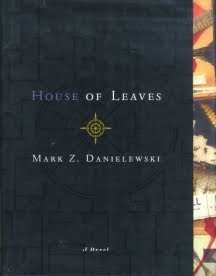 Though few will ever agree on the meaning of the configurations or the absence of style in that place, no one has yet to disagree that the labyrinth is still a house. Therefore the question soon arises whether or not it is someone's house. Though if so whose? Whose was it or even whose is it? Thus giving voice to another suspicion: could the owner still be there? - An excerpt from The Navidson Record


 Posts
Posts


