Showing posts with label French Literature. Show all posts

Sunday, April 1, 2012

"Now it is time for their just cause to be taken from Pharoah's hands, . . ."


. . . and for this reason, we three ladies whom you see here, moved by pity, have come to you to announce a particular edifice built like a city wall, strongly constructed and well founded, which has been predestined and established by our aid and counsel for you to build, where no one will reside except all ladies of fame and women worthy of praise, for the walls of the city will be closed to those women who lack virtue." (10-11)

Christine de Pizan (1363-c. 1430) was Venetian-born French author and scholar. Following the death of her husband in 1390 she turned to writing to support herself and her three children, possibly making her Europe's first professional female writer. While best known for her poetry, Christine also composed intellectual treatises and enjoyed royal patronage in both France and England. She was also famous for openly attacking the misogyny of her day, especially as it appeared in the works of male authors, leading many in recent years to proclaim her the first feminist in Western history. Christine often sought out female collaborators for her works, including a manuscript illuminator known only as Anastasia.

Le Livre de la Cité des Dames (The Book of the City of Ladies) was written in 1405 in vernacular French with Latin syntax and conventions. It grew out of Christine's ongoing response to Jean de Meun's The Romance of the Rose, which depicted woman as little more than lustful seducers. Still, as Christine notes at the start of her work, The Romance of the Rose was but one example of the continued vilification of women in the practically all-male Western canon. Women - according to innumerable philosophers, poets, theologians, scholars, and so forth - are relentless gossips, childish, vain, greedy, capricious, disloyal, and licentious predators. Unlike the male reader, Christine does not have the luxury of being able to select a book for light entertainment and expect not to be hurt and attacked. The Book of the City of Ladies is precipitated by just such an event: a book by one Mathéolus that she happened to pick up only to be confronted by all manner of slander against women. Christine internalizes his message and feels ashamed of herself for being of such a degraded sex.

As with Dante (c. 1265-1321), Christine is a character in her own work and initially introduced as having strayed from the true path into darkness and confusion. If it were not so that women are such contemptible creatures, she argues to herself, then so many esteemed men would not have made such pronouncements against them. Her Virgil-like figures who arrive to guide her in her hour of need are three heavenly beings called Lady Reason, Lady Rectitude, and Lady Justice who suddenly materialize in her study.
"Dear daughter, do not be afraid, for have come not to harm or trouble you but to console you, for we have taken pity on your distress, and we have come to bring you out of your ignorance which so blinds your own intellect that you shun what you know for a certainty and believe what you do not know or see or recognize except by virtue of many strange opinions. You resemble the fool in the prank who was dressed in women's clothes while he slept; because those who were making fun of him repeatedly told him he was a woman, he believed their false testimony more readily than the certainty of his own identity. Fair daughter, have you lost all sense?" (6)
They propose the construction of an indestructible City of Ladies, stronger and more glorious than any city that has come before it, and shelter to the legions of great women who have lived throughout Christian and Classical history. For medieval thinkers like Christine and Dante, the city was the epitome of civilized life. The city of Dis in the Dante's Fifth Circle of Hell is the aberration of something noble, particularly in the context of St. Augustine's writings on the City of Man vs. the City of God. The former is merely the temporal, imperfect representation on earth of the heavenly order, governed by laws and dependent on the goodwill of its citizens toward one another. Christine's conception of a City of Ladies is akin to the City of God in this respect, a subtle emphasis on the divine qualities of the female sex contrary to what is often said of them in Western literature and society.


The Book of the City of Ladies is an example of medieval allegorical writing, usually manifested as a dialogue between the author and imaginary characters who represent virtues or other abstract notions. The construction of the City of Ladies in this way serves as the framing device for a long stream of supporting evidence to counter the claims of misogynist men. The bulk of Christine's work is a series of anecdotes recited by the three Ladies which compose the metaphorical walls and building blocks of her eternal city. Thus, the allegorical city is the means to return voice to the voiceless and preserve for posterity the achievements of extraordinary women.* In medieval Christian tradition, the Word, or logos, is associated with light and order, and the path out of the dark wood of error and irrationality. In fact, etymology of our word "fame" comes from the Greek/Latin words meaning "to speak." Despite the strongly Christian foundation of her work, Christine presents Christian and pagan women in equal light, thereby emphasizing female goodness as innate and universal. Many of her heroines are derived from Classical mythology, which she incorporates into the Christian worldview just as Dante did in The Divine Comedy. Goddesses such as Minerva are portrayed as real human women of such greatness that they were deified by pre-Christian peoples.

Although the litany of anecdotes eventually grows monotonous it is interesting to note the values dissonance between Christine's medieval proto-feminism and the secular feminism of modern times. In response to charges of women's capriciousness we are given tales of wives whose husbands put them through all sorts of horrible trials to test their faithfulness. We have one woman, for example, who allowed her husband to kill both their children (they were actually hidden away at their aunt's estate) and then cast her aside and force her attend his wedding to his new bride (who was actually their daughter - he was about to end the charade). That she did not flee him or retaliate in any way and continued to treat him with kindness and respect is supposed to demonstrate the qualities of a dutiful and persevering wife. Many of the anecdotes concern women who endure Christ-like suffering, often at the hands of men, and are praised for their lack of any backbone whatsoever. Their role models are the female martyrs of the early Church who joyfully submitted to gruesome tortures and whose stories form the climax of Christine's book as the City's chosen residents. (This also further links the City of Ladies to the heavenly City of God.) We do hear a great deal about female warriors and leaders but those who acted independently of male relatives - most notably the Amazons - were the pagans of yore.

On the other hand, we do hear of female intellectuals whose cerebral feats more than match those of their male counterparts, which really slaps down any insult to women's intelligence. The affirmation of women as thinkers and scholars was doubtlessly of great importance to Christine, whose livelihood depended on her legitimacy as a writer. Regardless of how they are meant to relate to men socially, Christine is firm in her convictions that women possess equal capacity when given the proper education and opportunities. Her own career is proof.

As an early work of female scholarship, The Book of the City of Ladies probably has more historical value than usefulness in attacking misogyny in the twenty-first century. As demonstrated above, much of Christine promotes as the paragons of virtuous womanhood contradicts the principles valued by feminism today: assertiveness, self-reliance, nonconformity, and the willingness to fight rather than submit to injustice. Given the cultural context in which Christine was writing, however, the suffering women can perhaps be viewed ironically, as the true face of women subordinated by a patriarchal order intent on maligning them, and whose deliverance is only possible through chance or God's will. In short, the book is a cultural artifact. It is nevertheless significant as a woman's literary achievement in a time when female education was neglected and few women could even read. Its sequel, The Treasure of the City of Ladies, came out shortly afterwards to showcase the impact of women's speech and actions in their everyday lives, particularly in the promotion of peace.

The first English translation of The Book of the City of Ladies was published in 1521 by Brian Anslay as Boke of the Cyte of Ladyes. It was largely neglected over the next 450 years until Earl Jeffrey Richards released his modern English translation in 1982.

* From the Marina Warner's foreword to the 1982 edition by Persea Books.


A Year of Feminist Classics is a project started by Amy, Ana, Emily Jane and Iris, four book bloggers who share an interest in the feminist movement and its history. The project will work a little like an informal reading group: for all of 2012, we will each month read what we consider to be a central feminist text, with one of us being in charge of the discussion. . . What we hope to achieve is to gain a better historical understanding of the struggle for gender equality, as well as a better awareness of how the issues discussed in these now classic texts are still relevant in our times. We welcome all voices and perspectives, and we would love it if you joined in and added your own.

Sunday, October 2, 2011

"I perceived differently my relations with the divine."

I could see myself as seconding the deity in his effort to give form and order to a world, to develop and multiply its convolutions, extensions, complexities. I was one of the spokes of the wheel, an aspect of that unique force caught up in the multiplicity of things; I was eagle and bull, man and swan, phallus and brain all together, Proteus who is also Jupiter. (146)

Marguerite Yourcenar (1903-1987) was a Belgian-born French novelist and essayist. In 1980 she became the first woman elected to the Académie française. She published her first novel Alexis in 1929 and moved to the United States a decade later to escape the outbreak of World War II. Mémoires d'Hadrien was published in 1951 to great critical acclaim.

Memoirs of Hadrian, translated from French by Grace Frick in collaboration with Yourcenar, is a fictionalized autobiography of the Roman Emperor Hadrian, who ruled from 117 to 138. He was one of the Five Good Emperors praised by Niccolò Machiavelli. Edward Gibbon, in his famous work The History of the Decline and Fall of the Roman Empire, characterized their rule as an era when "the Roman Empire was governed by absolute power, under the guidance of wisdom and virtue." Hadrian did in fact write an autobiography but it has since been lost. Yourcenar portrays him as the quintessential "enlightened despot": a deep thinker and well-rounded, experienced statesman who directed his power toward the public good.

At times he seems almost too perfect, but such is probably in keeping with his personality as he composes the history of his own life. Hadrian's appreciation for the highest gifts of civilization - art, philosophy, rule of law - combines with breathtaking prose to recreate an Elysium that reigned briefly before the Dark Ages. The lost world of the Roman elite is one of palatial villas on the shores of the Mediterranean, deeds of daring on the barbarian frontier, and the ancient cults of Egypt and the Near East. Hadrian's conception of divinity extends from his secular knowledge, imagining the gods as innately connected to the various facets of human life. He is especially enamored of beauty in all of its forms, from poetry to soaring architecture to the vitality of youth. The climax of his story is the early death of his lover Antinous by suicide, although for all his rhapsodizing it appears that Hadrian loved him physically but not quite as a full individual. Antinuos was a Tadzio who manifested an ideal or exalted concept. Hadrian had him deified after his death, a megalomaniacal move that nevertheless transcends mere egotism and becomes poetry itself - an epic tale of love lost and the death of beauty in full bloom.

The breadth of Hadrian's lifetime, extending from far-off battles and travels to the depth of his learning, gave Marguerite Yourcenar a large canvas with which to work. She takes maximum advantage of the material offered to her and the result is a brilliant book and homage to what was seen centuries afterwards as one of the Golden Ages of Western civilization. A fascinating and rewarding read.

Shop Indie Bookstores


Marguerite Yourcenar's Memoirs of Hadrian was The Wolves' reading selection for September. Please feel free to join us for the rest! You can find the complete book list here.

Monday, August 8, 2011

"My posting to China has taught me what greatness and what misery a soldier can know:"

. . . on orders he moves from one place to the next without knowing where he is going or why. A pawn among many others. He lives and dies anonymously in the name of a greater victory. The game of go is changing me into a senior officer who uses his men coldly and with calculation: the stones make their steady progress, many condemned to die for the sake of a wider strategy.

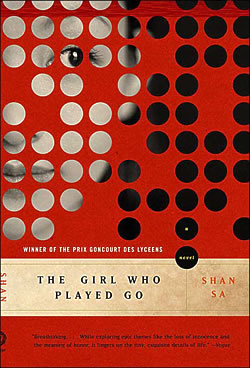
Shan Sa (1972-) was born in Beijing. She moved to Paris in 1990 and studied art for two years under the painter Balthus. Her debut novel Les quatre vies du saule won the Prix Goncourt du Premier Roman in 1998, which was followed by the 2001 Prix Goncourt des Lycéens for La Joueuse de Go (The Girl Who Played Go). Sa is also a painter who has exhibited in Paris, New York, and Shanghai.

The Girl Who Played Go (translated from French by Adriana Hunter) is a star-crossed love story set in occupied Manchuria in the late 1930s. Its voices alternate between two nameless protagonists born worlds apart but destined to collide in a cruel gesture of fate. The first is a Chinese schoolgirl from a worldly but faded aristocratic family. Nearing her sixteenth birthday, her typical teenaged pastimes take a dangerous edge as her newfound sexuality pulls her into a love triangle with two resistance fighters. The second is a Japanese soldier in his early twenties whose relentless focus on honor and national glory is turning him into a war criminal. In an effort to flush out underground "terrorist" cells, the soldier's Captain has ordered him to pose as a Chinese civilian and infiltrate the go square, which the Captain believes is "just a camouflage: it's there on that square, as they pretend to play their war game, that our enemies are putting together their twisted strategies." Both narrators are skilled at this ancient contest of will and intellect and commence a long, drawn-out game that has them seeing one another with greater frequency, even as the situation around them steadily worsens.

Sa is one of those rare authors able to speak volumes with deft, sparse prose. Every word is chosen carefully with none wasted on extraneous exposition or flowery description. Her unflinching portrayal of war cuts like a razor. Most writers would have turned this scenario into a treacly (and not to mention offensive) BRING ME TOOO LIIIIIIIFE story of a Darth Vader type who "still has good in him" and the Love of a Virtuous Woman. Sa brings us instead a pair of complex and often unsympathetic characters whose relationship is never anything grander than two strangers making hesitant contact. Indeed, the love story is actually secondary to the war itself in fitting with the game of go as a metaphor for the insignificance of the individual in life-and-death struggles for conquest and freedom. Sa sacrifices none of her realism to starry-eyed fantasy and the ending is inevitable from the beginning.

The Girl Who Played Go is a powerful work. Though not marketed as YA, older teens will relate to the girl's adolescent struggle for self-realization, which, along with the Marxist idealism of the Chinese resistance, foreshadows the upheavals of Maoism and its attacks on tradition. In fact, she is one of the strongest and most memorable female protagonists I have come across in some time. Her male counterpart is no cardboard cutout either. His chapters reveal a growing dissonance between his patriotic values and the brutalities regularly committed by his comrades. The Girl Who Played Go is a study in contrasts: the dehumanization of war revealed through a highly intimate look into the hearts and minds of two individuals. Highly recommended.

Trigger warning for sexual violence and a graphic torture scene.

Note on the translation: This is the second French novel translated by Adriana Hunter I have read and once again, her work is flawless. The first was Véronique Olmi's Beside the Sea, another dark story that will haunt its reader afterward. I will definitely keep my eye out for more Hunter translations in the future.

Shop Indie Bookstores

Wednesday, April 20, 2011

"The story is made of twists, detours and many hesitations."

A Little Party Dress
By Christian Bobin
Translated from French by Alison Anderson
77 pages
Autumn Hill Books
December 1, 2009


. . . The story is like a piece of cloth folded in eight. As you read it you unfold it, it becomes bigger and bigger, ever more luminous to your eyes. A silk of pure sky. ("The Frailty of Angels")

Christian Bobin was born in Saône-et-Loire in 1951. In 1993 he was awarded the Prix des Deux Magots for his novel Le Très-Bas (The Secret Life of Francis of Assisi in English). His favorite form, however, is the fragment - a little picture representing a moment in time.

1994's Une petite robe de fête (A Little Party Dress, translated by Alison Anderson) is a collection of lyrical essays, a mode that combines the reflective essay with the prose poem. Each one is a brief rumination, like the snippet of a dream or pause in the midst of daily life, with a focus on childhood and the transcendental power of literature. Bobin's introduction establishes a link between the two with reading as the boundary between innocence and knowledge.

The three recurring tropes are the imaginative child, the transported reader, and the dull non-reading adult. The relationship between them is an uneasy, paradoxical one. Learning to read represents "a little piece of god departing, a first fracture in paradise," yet also keeps alive that spirit of boundless creativity. In the end, human growth is inevitable and accompanied by responsibility and conformity.
She leaves the white horse with regret. Each time it's the eternal question, the dark riddle: why can't I stay there? Since I'm happy there. Since when I'm close to the white horse I'm closest to myself. Why do I have to progress, to continue, when then are there all these hours that take me away from myself and from everything that matters. You don't know how to respond. You can't respond, because like her you've already met your own life in play - and nowhere else. ("Look at me, look at me")
The reading adult is the compromise between the two, standing apart from, say, a crowd of businessmen, the "same man, in dozens of copies. . . You look at them fearfully, the way as a child you used to look at dried-up old people with their somber voices" ("Promised Land"). Loss is another central motif, stemming from that original loss in the early days of school. To adults, this is often the loss of love, explored in the title piece as a redemptive but transient echo of childhood.

A Little Party Dress ultimately fulfills its own themes as the perfect book to come back to again. No essay is more than ten pages, wonderfully suited for those quiet moments in time when the philosophical mood sets in. Recommended.


Shop Indie Bookstores


Review Copy


Monday, November 22, 2010

"I'm going to save myself despite the world that persists in going forward laboriously at the speed of a handcar operated by a man with one arm"

Zone
By Mathias Énard
Translated from French by Charlotte Mandell
517 pages
Open Letter Press
December 14, 2010


. . . I thought about Harmen Gerbens the Dutchman and about his apartment, about the Jews of Cairo and Alexandria who came through Spain in 1967, about all those movements in the Zone, ebb, flow, exiles chasing other exiles, according to the victories and defeats, the power of weapons and the outline of frontiers, a bloody dance, an eternal interminable vendetta, always, whether they're Republicans in Spain fascists in France Palestinians in Israel they all dream of the fate of Aeneas the Trojan son of Aphrodite, the conquered with their destroyed cities want to destroy other cities in turn, rewrite their history, change it into victory, in other places, later on, . . .

France's Mathias Énard has lived in the Middle East, as well as in Barcelona as a professor of Arabic. He was awarded the Prix des Cinq Continents de la Francophonie and the Prix Edmée de la Rochefoucault prizes for his debut novel, La perfection du tir, and the Prix du Livre Inter and the Prix Décembre for his second work, 2008's Zone.

Francis Servain was born to a cultivated Croatian mother in exile and a French engineer haunted by his murky actions during the Algerian War. Influenced by neo-fascist identity politics and his grandfather's own involvement in the Ustaša movement, Servain, at a young age, returned to his ancestral homeland and fought for a free Croatia during the Bosnian Civil War. After finally fleeing the genocide and senseless chaos, he joined French intelligence and began to specialize in underworld networking throughout the "Zone" - that volatile region surrounding the Mediterranean. From Israel and the West Bank, to Libya and Lebanon and Turkey, to Spain and Syria, Servain became intimately acquainted with an ongoing cycle of violence perpetually spawning new violence in a never-ending dance of death dating back to the mythological histories of Greece and Rome. He has left all this behind now and changed his name so they can't find him. He is on a train in Italy heading to Rome with a suitcase full of names, beginning with an old Nazi living in Egypt. He is taking this suitcase to the Vatican, hoping for some kind of absolution.

Zone is bleak. It is a litany of atrocities strongly reminiscent of "The Part About the Crimes" in Bolaño's 2666. It is also a single, rambling, stream-of-conscious sentence, nearly five hundred pages long and interrupted only by two excerpts of a novel-within-a-novel about a female Palestinian in Beirut in 1978, on the eve of its fall to the Israelis. Although it is never stated outright, Servain is clearly plagued by PTSD, as seen in his inability to stop the memory reel no matter how much alcohol he consumes. But The Sentence is more than just a recitation of Servain's knowledge, feelings, and experiences. It is also a textual manifestation of war with no end or perhaps a Matryoshka doll - one individual's gruesome past, uncovered, reveals links to other conflicts in other countries. Zone is ultimately a protest against man's continuing folly. It is not so much that "those who forget history are doomed to repeat it" as it is simply that history is maybe the only thing left alive. History - collective and personal - inspires the ideologies and other excuses people use. The greatest force of them all is probably vengeance.

It is interesting that Servain at one point finds himself thinking about William Burroughs writing Naked Lunch in Tangiers. The Zone, as Servain knows it, really does recall Burroughs's Interzone in both name and spirit - a total Crapsack World, laid out in breakneck prose and violent to the extreme. But whereas Burroughs sought to satirize the hypocrisies and hidden animosities of mid-century America, Zone is about these underlying prejudices and impulses brought to the fore. Francis Servain's father was a mild-mannered man who enjoyed model trains and had participated in "special interrogations" in Algeria. Servain himself is a sympathetic war criminal, which should be a contradiction in terms. And herein lays the real despair of Énard's work: in this potential that exists in just about everyone, and how our denial of our own darkness leads only to the "othering" and dehumanization of our enemies as monsters who had it coming.

"It says 'Death' on every page," says one critical review of 2666. ". . . The bleakness of Bolaño's vision radiates out, but so little understanding comes with it." You can make the same charge against Zone as well. Énard's unrelenting focus on war in a single sentence of over 500 pages borders on repetition and nearly becomes exhausting. But maybe that was his intention. Reading about war is trying; try living it. I'm not sure Zone really has a point, at least not a redemptive one. What I did get out of it, though, was a sense of horror not only at what people go through but at what they put themselves through. Zone is closer to a documentary than a work of fiction (Énard's research included journalists, historians, and filmmakers) and I think that's how it should be approached. It's not holiday reading, that's for sure.


Review Copy


Tuesday, June 15, 2010

"the ones that take me straight to the place I mustn't go"

Beside the Sea
By Véronique Olmi
Translated by Adriana Hunter
111 pages
Peirene Press
February 4, 2010


It's lost. Fallen into a hole. You struggle to live as best you can but soon the whole lot disappears. We get up in the morning, but that morning doesn't actually exist any more than the night before which everyone's already forgotten. We're all walking on the edge of a precipice, I've known that for a long time. One step forward, one step in the void. Over and over again. Going where? No one knows. No one gives a stuff.


Véronique Olmi is an award-winning dramatist currently living in Paris. 2001's Bord de Mer (Beside the Sea) was her first novel. A bestseller in its native France, Beside the Sea has since been translated into all major European languages, and now in English as Peirene Press's debut release. Olmi's seventh and most recent book,
Le Premier Amour, came out earlier this year.

Beside the Sea is very short and spans a mere 24 hours. The narrator arrives late at night in an unnamed coastal town with her two little boys in tow: nine-year-old Stan and five-year-old Kevin. Although she has been saving her money for some time, the trip is poorly planned and she is barely able to orient herself and find a hotel. It is apparent from the start that something is not right. There are references made to social workers, a psychiatrist, and medication she is not presently taking. Her overwhelming desire to protect and shelter her children is amplified by paranoia, intense anxiety, and depressing thoughts about the state of the world and other people. As the day progresses and her delusions increase, the result can only be tragic.

A couple weeks ago I reviewed Margo Lanagan's Tender Morsels, which has similar themes of motherhood, psychological trauma, and the harm done to children. I argued that that particular book (432 pages) should have been much shorter to better drive home its emotional impact. I cited several novellas as examples of powerfully condensed writing, but now feel that Beside the Sea best illustrates the point I was trying to make. Olmi's prose is fast-flowing and rambling yet still manages to convey the slow suffocation of its narrator. It actually reminded me of Ferenc Karinthy's Metropole in the way the reader is swept along as though trying to escape an oppressive atmosphere. Due to its length, Beside the Sea has to spring forward from the very first page and relentlessly push ahead with little digression. There's no time to stop and catch a breath, which only intensifies the reading experience.

Now I'm not sure if the narrator is literally supposed to be schizophrenic (she seems to exhibit some of its symptoms, including auditory hallucinations) but it's worth noting that its etymology derives from the Greek words skhizein and phren, meaning "to split" and "mind."* Beside the Sea is a story of dissonance and the clash of opposing halves, of mental darkness and the "good mother" trying to reconcile in one individual. On the surface, she is simply taking her children on an outing to the beach and the fair. But the tragic irony is that this picturesque family image, which this mother tries so hard to realize, crumbles into the most monstrous act a parent is capable of. The real power of Beside the Sea is precisely this juxtaposition of the idyllic and the aberrant. It would be easy to condemn this woman but Olmi skillfully evokes our sympathy for someone whose maternal love went all too wrong.

Obviously, this is a very intense read. Véronique Olmi took on the difficult task of articulating mental states nearly beyond words and succeeded almost too well. Beside the Sea is frightening not only because of its ending but because its troubled protagonist is so relatable. Her character is not as alien as we would like it to be. Her duties and feelings as a mother are reflected right back at us and we can't comfortably detach her from the rest of humanity. Beside the Sea is the type of book that will remain with the reader for a long time afterwards and requires a certain amount of bravery to approach. Strongly recommended.

* Contrary to popular belief, schizophrenia is not a split personality disorder.


A special thanks to Meike Ziervogel for this review copy.


Sunday, June 6, 2010

"only people of leisure can attain a way of thinking that is truly civilized"

A Splendid Conspiracy
By Albert Cossery
Translated by Alyson Waters
213 pages
New Directions Publishing
May 25, 2010


Teymour was waiting for Felfel in front of the statue of The Awakening of the Nation. In her stylized dress the woman was still raising her arm to encourage a heedless people to revive but, as if responding to her ludicrous call, against the metal railing that surrounded the monument, a vagrant was sleeping, snoring shamelessly and thus undermining the morale of his fellow citizens with his unfortunate conduct; whether by coincidence or design, serious damage was being done to the government's attempt - by means of this insomniac and imperious peasant woman - to rouse the crowds from their torpor.

Albert Cossery (1913-2008) was a French writer born in Cairo to a family of Greek Orthodox Syrian and Lebanese descent. Inspired by Honoré de Balzac, he moved to Paris at 17, ostensibly to study, which he never did. In his 60 years of writing he only produced eight novels, in keeping with his personal philosophy of laziness as a form of meditation and contemplation. Although he lived in Paris all his adult life, Cossery's ironic, irreverent books set in Arab countries established him as "the Voltaire of the Nile."

A Splendid Conspiracy, originally written in 1975 as Un Complot de Saltimbanques, opens with Teymour, a young man whose wealthy father has recently called him back from Europe to their small, unnamed Egyptian city. Although Teymour had been sent abroad to obtain a degree in chemical engineering, he never actually enrolled in any classes and spent the entire six years learning about the various forms of debauchery found in the great Western capitals. His "diploma" was purchased for a large sum of cash several days before his departure.

Luckily, Teymour's self-pitying funk doesn't last for long. His childhood buddy Medhat reminds him that every country has its share of "imbecils, bastards, and whores" ready to make life fun and amusing. Their mutual friend Imtaz, a disgraced actor, heartily agrees with this, and A Splendid Conspiracy is for the most part concerned with the trio's neverending drinking, dancing, and womanizing. Their crowd also includes Rezk the reluctant police informant; Chawki, a buffoon with too much money and a taste for schoolgirls; Salma, one of Chawki's former conquests who earns her revenge through his maintenance of her lavish lifestyle; and Samaraï, a lovestruck veterinary student whom the man-hating Salma enjoys tormenting. Just when things couldn't be more exciting, the town's prominent men have been disappearing and police chief Hillali thinks Teymour, Medhat, and Imtaz are the revolutionaries responsible.

It appears to be a simple enough story on the surface. Cossery's prose, though hardly minimalist, is straightforward and unadorned and rarely goes beyond candid narration. But, as Medhat explains, there are always "great gifts of madness and murderous rage" seething beneath every humdrum surface. A Splendid Conspiracy may seem like a carefree romp. But Cossery's irony is rich, beginning with the recurring image of a patriotic statue with her hand outstretched before the impassive city. It is a futile gesture. In a tale of idleness, "The Awakening of the Nation" is two-faced and ridiculous, the perfect symbol of what our trio perceives to be history's greatest con. According to Medhat (the most articulate of the bunch),
"From the beginning man's hardworking fate has made him unable to conceive of an ideal that is not material and does not correspond to his needs and his safety. All he thinks about is earning a living; this is what he is taught from childhood on. His only aim is to become cleverer and more of a bastard than everyone else. During his entire lifetime, he uses his ingenuity to provide food for himself and, once he has eaten his fill, to invent some sordid ambition for himself. When, then, does he have time to elevate his spirit and his mind? The tiniest thought along these lines is considered a criminal offense, immediately punishable by disapproval and starvation. Therefore, I venture to affirm that only people of leisure can attain a way of thinking that is truly civilized."
Such an attitude is profoundly selfish, of course, as Medhat & Co. make it clear that they care nothing for those lacking class privilege except to sleep with their women. Their "enlightened" position is made possible by a good dose of male privilege as well, and both advantages are innately bound to the oppression of others. Hence, the gang's laziness and debauchery is dependent on other people being denied the opportunity for laziness and debauchery. (As for Salma, the culture considers her a "dishonored woman." Although she enjoys playing this up for effect, she is still a social outcast dependent on the good graces of the man who ruined her.) Given the obvious similarities between author and characters, it is easy to dismiss A Splendid Conspiracy as a sexist, elitist ode to the libertine. A valid criticism - in some respects, it is: Salma is a shrill harpy and adolescent girls are naught but sex objects.

For all its blithe carousing, however, the "civilized life" is founded on a kind of nihilism that finds its starkest expression in the mystery of the missing men. Police chief Hillali's suspicion of violent, treacherous action comes from precisely our trio's seeming inaction. It is impossible to remain idle for this long, he argues, especially when you are educated, because with all that time to reflect you can't possibly have not noticed that "this world is abject and revolting." A sentiment Medhat, Imtaz, and Teymour actually agree with, but that doesn't mean they wish to change anything about such a world. They are apathetic in every sense of the word. If most actions that fall outside the realm of pleasure are stupid and ignoble, then it goes to follow that performing said actions only contributes to an overall slave mentality. Therefore, most such ambitious bastards are too stupid too live and our heroes will most certainly not lift a finger once they learn (accidentally) the true cause of the disappearances. Even if one of their friends becomes a victim. The more that go, the merrier.

I agree with another reviewer that all the characters are basically repulsive. But take comfort: Chawki, the bloated, vulgar doofus at the butt of the gang's jokes and despised by respectable society, is, in Albert Cossery's ultimate blast of irony, the very vision of Teymour, Medhat, and Imtaz's sordid future. They've already got all the ingredients. Joke's on them and their "enlightenment." Again, if someone were to condemn A Splendid Conspiracy as mere exploitation and misogyny, I would totally understand and actually agree to an extent. Still, I also found it surprisingly self-aware and self-critical and thoroughly enjoyed reading it. Am very interested in hearing what other people think.

Click here for an excerpt.


A special thanks to Alyson Waters for providing me this book and introducing me to a new author.


Friday, April 30, 2010

STUFF

Let us imagine a man whose wealth is equalled only by his indifference to what wealth generally brings, a man of exceptional arrogance who wishes to fix, to describe, and to exhaust not the whole world - merely to state such an ambition is enough to invalidate it - but a constituted fragment of the world: in the face of the inextricable incoherence of things, he will set out to execute a (necessarily limited) programme right the way through, in all its irreducible, intact entirety.

Georges Perec's La Vie mode d'emploi (Life: A User's Manual) is a humongous book. Specifically, it's 568 pages, which may not seem too bad, but it's 568 pages of stuff. Tons and tons and tons of it. Layers and layers of minutiae. Lists that go on and on and on, many of which I literally skipped over. Do I really need to know every last item Madame Marcia has in her antique shop?

I do because there is a mathematical formula at work here. According to Wikipedia:
These elements come together with Perec's constraints for the book (in keeping with Oulipo objectives): he created a complex system which would generate for each chapter a list of items, references or objects which that chapter should then contain or allude to. He described this system as a "machine for inspiring stories".

There are 42 lists of 10 objects each, gathered into 10 groups of 4 with the last two lists a special "Couples" list. Some examples:
  • number of people involved
  • length of the chapter in pages
  • an activity
  • a position of the body
  • emotions
  • an animal
  • reading material
  • countries
  • 2 lists of novelists, from whom a literary quotation is required
  • "Couples", e.g. Pride and Prejudice, Laurel and Hardy.
The way in which these apply to each chapter is governed by an array called a Graeco-Latin square. The lists are considered in pairs, and each pair is governed by one cell of the array, which guarantees that every combination of elements is encountered. For instance, the items in the couples list are seen once with their natural partner (in which case Perec gives an explicit reference), and once with every other element (where he is free to be cryptic). In the 1780s, the great mathematician Leonhard Euler had conjectured that a 10×10 Graeco-Latin square could not exist and it was not until 1959 that one was actually constructed, refuting Euler.

To further complicate matters, the 38th and 39th list are named "Missing" and "False" and each list comprises the numbers 1 to 10. The number these lists give for each chapter indicates one of the 10 groups of 4 lists, and folds the system back on itself: one of the elements must be omitted, and one must be false in some way (an opposite, for example). Things become tricky when the Missing and False numbers refer to group 10, which includes the Missing and False lists.
ASEDRTGFVBNMKLK WTF???

Background: Perec was a member of the Oulipo group of French writers and mathematicians united by their interest in "constrained writing," a literary technique in which a work is produced under certain self-imposed restrictions. Poetry is the most common example, since genres such as haiku and the sonnet require a very specific verse structure. In prose, constrained writing often takes the form of omitting certain words or letters, or, as in Perec's case, conforming the narrative structure to a particular pattern. Both Perec and one Ernest Vincent Wright have also written novels without using the letter "e," despite it being the most common letter in both the French and English languages. Le Train de Nulle Part (The Train from Nowhere), a 2004 novel by Michel Dansel, does not have a single verb.

Hence, Life: A User's Manual is one giant word game. Or a puzzle, which is Perec's biggest motif.

Bartlebooth is a wealthy and eccentric Englishman who owns 11 Rue Simon-Crubellier, the fictional Parisian apartment building where the novel takes place. His entire life has been devoted to one singular project. Over a twenty-year period, beginning sometime shortly before World War II, he traveled the world with his faithful servant Smautf, painting scenes of various ports at a rate of every two weeks for a grand total of 500 watercolors. The finished painting is faithfully mailed back to Paris on regular schedule, where Gaspard Winckler, recruited by Bartlebooth specifically for this purpose, attaches it to a wooden support and cuts it into a jigsaw puzzle. Following his return to 11 Rue Simon-Crubellier, Bartlebooth will spend the remainder of his life solving every one of the 500 puzzles. Each reassembled product is then passed onto Georges Morellet, a chemist also carefully selected by Bartlebooth, who treats the puzzle with a solution of his own invention that rebinds the paper. Finally, the recreated painting is mailed back the port it depicts where it is submerged in saltwater until not a trace of the watercolor is left. Bartlebooth intends to leave behind no evidence of half a century's labor.

Smautf, Winckler, and Morellet are also residents of 11 Rue Simon-Crubellier, along with Valène, the artist who tutored Bartlebooth before he commenced his world tour, and various families and individuals of varying histories and circumstances. Madame Moreau is the elderly self-made owner of a giant manufacturer-seller of tools, craft supplies, and DIY kits. Dr. Dinteville runs his own clinic and laments the failure of his research career. The Altamonts are planning a party. Cinoc works as a "word-killer" eliminating obsolete definitions from the Larousse dictionary. Madame Albin used to own a French printing press in Damascus until anti-colonialist sentiment forced her and her husband to flee the country, following which her husband died and her fortune was largely consumed by various court cases. All of these and others are frozen in time on June 23, 1975 at 8:00 pm, when Georges Perec removed (figuratively) the facade of 11 Rue Simon-Crubellier, exposed each room, and carefully laid out the contents and activities therein.

For the reader's convenience, the book also comes with a map of the building, an index, chronology, "alphabetical checklist," and postscript advising us that Life: A User's Manual contains quotations, some slightly altered, of a diverse group of writers that includes Italo Calvino, Jorge Luis Borges, Gustave Flaubert, James Joyce, Franz Kafka, Marcel Proust, Jules Verne, Vladimir Nobokov, Sigmund Freud, Herman Melville, Agatha Christie, and Gabriel García Márquez.

You could make like Bartlebooth and spend your whole life on one mission. Namely, this book. I wonder if Perec's brain ever just seized up due to the sheer amount of stuff that spills out over the course of 568 pages, like someone just emptied a whole giant bucket of miscellanea.

I don't do math, so I couldn't approach Life from that particular angle. Unfortunately, the Graeco-Latin-Euler-array-square 10×10 mumbo-jumbo is what unifies and orders all of Perec's clutter. It's like seeing the trees but being unable to comprehend the concept of a forest. Ohmigod, TREES PLANTS LEAVES LOGS STICKS EVERYWHERE! What could this be?

I can discern, however, a running preoccupation with the detective genre. Several mystery novels are included in the lists of stuff found in some of the rooms and even on the public stairway. A boy and his friends draw a crime serial for their school paper and then can't figure out how their investigator progresses from the initial question (whodunit?) to the solution. I seem to recall a couple of other examples but they have since been submerged in the sheer volume of stuff. But anyway, what I get out of this is a desire for order. The job of every sleuth, whether a hardboiled LAPD homicide detective or the small-town amateur in a cozy, is to sort and organize incoming information, stemming from the crime itself, until a pattern is articulated and then followed to its logical conclusion (whodidit!).

In other words: the detective looks at life and ascertains a design at work. A problem arose, whether suddenly or over a period of time. There was a catalyst. A crime was committed. The guilty party tried to cover their tracks. It's a recognizable narrative.

But there's also that messy entropy thing. Even if you can extract a single strand of narrative - beginning, middle, end - out of the vastness of one, two, or several lives, any attempt to impose order on an entire individual life (let alone more than one) is impossible. Your work will unravel, as life is ultimately too big to be confined to any one framework. (That's the philosophical conundrum behind every (auto)biography - see Gert Jonke's novel/memoir The System of Vienna.) Bartlebooth attempts to give his existence a unifying purpose and ends up failing when his eyesight gives out and Winckler gets a little too good at making puzzles. Bartlebooth dies trying to complete number 439.

So what I'm left with is a contradiction of sorts. On the one hand, life is full of stuff that defies organization. Yet Perec did organize it by first starting out with his crazy mathematical pattern idea and building his book from there. But then again, everything arose entirely from his own imagination to begin with so I'm not sure that's really such a contradiction after all.

In conclusion, I have to say that for some reason I did enjoy reading Life: A User's Manual despite being unable to comprehend the forest. (I hope I didn't mess up that metaphor.) But if someone were to say that they just hated it, I would totally understand.

Update: Richard linked to this diagram. I still don't get it.


Life: A User's Manual was our Unstructured Group Read for the month of April. Please feel free to join us at any time! You can find a complete book list here.

Other April participants include:

Claire
Emily
Frances
Julia
Richard

Past selections:

March 2010: Tennessee Williams, The Night of the Iguana


Saturday, January 9, 2010

Urban Legend

I felt the great power that certain places, certain sights exercised over me, without discovering the principle of this enchantment. Some everyday objects unquestionably contained for me a part of that mystery, plunged me into that mystery. I loved this intoxication which I knew how to put into effect, although ignorant of its causes. . . Slowly, a desire sprang up in me to find out what was the link between all these anonymous pleasures. I felt sure that the essence of such pleasures was entirely metaphysical and involved a sort of passion for revelation with regard to them.

Louis Aragon (1897-1982), along with Philippe Soupault and André Breton, was one of the founders of Surrealism, which evolved out of their involvement with Dadaism. Surrealism, as outlined in Breton's Manifesto of 1924, can be best summed up by a simple phrase: There is a man cut in two by the window. As Breton explained it, Surrealism is the arrangement of two distinct realities fused together in an uncanny union. As such, the artist must recognize the value of the ordinary and everyday, but must also interpret them with the full range of their imagination pursuant to the Hegelian Dialectic, which lays out three stages of development. The first is thesis, an idea that must be reacted to; the second is antithesis, which is the reaction's negation of the thesis; and the third is the resolution of the conflict by means of synthesis.

(Hegel himself, however, actually ascribed that model to Kant and preferred the formula "Abstract-Negative-Concrete," which suggests that the initial thesis may be flawed in both its abstract ambiguity and its lack of the negative controls of trial, error, and experience.)

Louis Aragon's Paris Peasant (Le Paysan de Paris, 1926) is, first and foremost, its author's attempt "to use the accepted novel-form as the basis for the production of a new kind of novel that would break all traditional rules governing the writing of fiction, one that would be neither a narrative (story) nor a character study (a portrait), a novel that the critics would be obliged to approach empty-handed . . . because in this instance the rules of the game would all have been swept aside." My original intent, Aragon would go on to say some forty years later, was to reverse the process of myth → romance that occurs when people have lost faith in the myth. Paris Peasant was to be a novel (roman) that would read as a mythology of the modern. "Then, without feeling reluctant any longer, I set about discovering the face of the infinite beneath the concrete forms which were escorting me, walking the length of the earth's avenues" (from page 115 of Paris Peasant). Tired of resorting to abstract fancies to understand the world, Aragon has resolved to trust in the imaginative arrangement of his immediate sensory input. In his original introduction he argues that,
Humanity's stupid rationalism contains an unimaginably large element of materialism. This fear of error which everything recalls to me at every moment of the flight of my ideas, this mania for control, makes man prefer reason's imagination to the imagination of the senses. And yet it is always the imagination alone which is at work. Nothing, neither strict logic nor overwhelming impression, can convince me about reality, can convince me that I am not basing reality on a delirium of interpretation. But in the case of the senses, man, after absorbing the teachings of various traditional schools, has begun to have doubts about himself; one can imagine by what play of mirrors this has been at the expense of the opposite thought process, reasoning. And here we have man a prey to a mathematics. In trying to free himself of matter he has become the prisoner of the properties of matter.
In a nutshell: Aragon has taken two disparate spheres - that of the real world, as revealed through his senses, and that of the imagination - and now seeks to elucidate his vision of a city whose people and passages conceal a rich subconscious that can be glimpsed only by the most open-minded viewer.

For his observations, Aragon chose the Passage de l'Opéra, a narrow corridor scheduled to be demolished in the near future so that a new accessway could be built to the Boulevard Haussmann. It is not the Paris that tourists visit: it is a shaded, winding pathway lined by dilapidated storefronts, questionable hotels, brothels, and restaurants of varying quality. "The whole fauna of human fantasies," says Aragon, "their marine vegetation, drifts and luxuriates in the dimly lit zones of human activity, as though plaiting thick tresses of darkness." Aragon perceives a siren in the window of a cane shop, floating among the artfully-displayed merchandise. He arrives at a women's salon and goes off on a rambling rhapsody on the beauty of blond hair, likening it to every lovely object he can think of, and then contemplates the history of hairdressing from its sensual beginnings to the cold, modern efficiency that characterizes it at present. The male customers, Aragon perceives, are all "pierced by a single mystery" and patronize the salon "to acquire the ingredients for their innate sense of illusion." He arrives at a bathhouse and ruminates on the power of public prurience, linking it to society's "taste for confusion" that tends to divert a given object from its original usage and attach to it all sorts of wild speculations. And then there is the common burlesque house, which is actually the ultimate in art, thanks to its strict appeal to the senses.

In his internal transformation of urban spaces, Aragon sees himself as reinventing the idea of the myth. All myths are created out of nature, which Aragon believes is "essentially metaphysical." In the modern world, however, nature can no longer be thought of as simply all that humans did not create and which possesses a divinity and beauty which human creation can never have. The new myths draw their inspiration from the same source: the external world, which Aragon views as "a single construct representing the limit of my mind . . . which enters my consciousness gradually and intermittently." That "sense of nature" people speak of is really a sense of their surrounding environment in general, similar to the conscious mind's sense of its own unconscious from which it arises, not unlike how myth arises from aspects of reality.

In other words, nature - defined as the entire external world, both untouched and artificial - is a collective unconsciousness. Whereas traditional religion demanded a meditative and introspective mood out of sync with the quickly-changing spirit of modern life, Aragon posits that humans now worship speed, as seen in the new cult of the automobile. As civilization increasingly urbanizes, it is only logical to assume that the new "gods" of the future may well be those forces humans have amazed themselves by taming and have then grown dependent upon. It is the machine, after all, that shapes modern life, while the city is where modern life takes place.

That's really only a slice of what Aragon was trying to do with Paris Peasant, which is best defined as a memoir/philosophical treatise (although Aragon hated philosophers). Unfortunately, unlike his contemporary Soupault's Last Nights of Paris, also written in the Surrealist vein, Paris Peasant is not an accessible work. My knowledge of Hegel and Surrealism is pretty shallow, and there were several passages that just went over my head. Aragon's frequently convoluted style didn't exactly help either. I was also in somewhat of a hurry to finish, however, and I think this book could definitely benefit from a more careful re-reading.

I was further bothered by Aragon's arrogance. For example, he was amused by the residents and business owners of the Passage de l'Opéra being upset by his depiction of the area (Paris Peasant was originally serialized in a newspaper edited by Philippe Soupault - unfortunately, I was unable to find any further information about that on the Internet and my edition's introduction is very scant), especially since it came at such a sensitive, difficult time for them. What he intended as irony, they were insulted by, though not that he seems to care, since he also shares in that stereotypical avant-garde hatred of bourgeoisie life. He is also thoroughly convinced of the truthfulness of his worldview and explicitly states, within the last several pages, that he denies anyone the right to legitimately criticize his work. Overall, Louis Aragon strikes me as kind of a jerk.

Paris Peasant does have its moments of brilliance, in both the ideas it presents and the language it uses to present them. It is also difficult and slow-moving and requires a strong background in philosophy and Modernist thought which the average reader is not going to have. I would recommend it to anyone willing to ponder some hefty concepts but this is definitely not the book for everyone.

Monday, January 4, 2010

The White Rabbit of Paris

But what gave her person a charm that could be described as special was her resemblance to a shadow. One might well be astonished, and I never failed to be so, by her strange ability to escape judgment. She resembled at times gleams of light, at times their sisters the shadows. Before memory and words she was as evasive as a fish. She withdrew, even while she remained present, or even when she became burdensome and immense.

Philippe Soupault (1897-1990) was a French poet and novelist. Though initially attracted to the anti-rationalism of Dadaism, Soupault eventually rejected its nihilism and, along with André Breton, sought to explore other revolutionary forms of self-expression. In 1919, Soupault, Breton, and Louis Aragorn (author of Paris Peasant, which I'll be reading next) founded the magazine Littérature, an event which for many marks the definitive start of the Surrealist movement. The following year saw the publication of Les Champs Magnétiques, a collaborative effort by Soupault and Breton to compose the very first book of automatic writing. 1928's Les Dernières Nuits de Paris (Last Nights of Paris), though authored solely by Soupault, may also be thought of as artistic collaboration. Its translator is none other than William Carlos Williams, who was introduced to Soupault by a mutual friend.

Last Nights of Paris concerns the after-dark exploits of its narrator (who never seems to sleep - or work, for that matter), who gradually becomes acquainted with the various nocturnal creatures of the City of Lights. Ever since witnessing a bizarre, weirdly staged spectacle conducted on the rue de Seine around midnight - involving a procession of laborers, a desperate woman, and a giant sack - the narrator has grown obsessed with his companion at the time, a young prostitute he had just met named Georgette, who seemed all too knowing of what exactly they were observing. Hearing a newspaper account the next day of a sailor who had killed and dismembered one of his friends, the narrator finds himself slowly drawn deeper and deeper into an underworld that comes to life only in the dark. Presiding over it all is Georgette, whom the narrator comes to view as the embodiment of all the moods and mysteries of the Parisian night.

Last Nights of Paris is set in the same city chronicled by Dorothy and Thomas Hoobler in their recent non-fiction book, The Crimes of Paris, which covers not only the 1911 theft of the Mona Lisa from the Louvre, but also a place alive with the experimental spirit of Modernism and in love with spectacles of all kinds. Parisians especially enjoyed hearing about criminals and crimes of all sorts, as seen in the gruesome productions of the Théâtre du Grand-Guignol, the wildly popular anti-hero Fantômas of the French pulps, and the sensational stories publicized by newspapers since the repeal of the censorship laws in the 1880s. The Great War may have ended the Belle Époque, but the provocative character of Paris survived into the 1920s, along with its place as the epicenter of radical thought in art and literature.

(Note the muted colors of the Fantômas poster, which are very Art Nouveau. Its cleaner, more streamlined look, however, seems to indicate the growing influence of Art Deco. Not surprising, since it is an early film poster and nothing reflected the speed and spirit of modern times like Art Deco.)

If real-life career criminal-turned-police investigator Eugène François Vidocq influenced Edgar Allen Poe's creation of the detective story, so too does Last Nights of Paris represent a mingling of two distinct cultures. "As the many memoirs of Paris in the twenties attest," says my edition's introduction, "the disparate worlds of the French avant-garde and the American expatriates rarely collided." As such, Williams's translation "stands at the unlikely juncture of both French and American literary modernism." With its cast of tough, amoral characters (including the obligatory femme fatale), evocative urban setting, and the protagonist's quest into the urban labyrinth unlock a puzzle, Last Nights of Paris is very reminiscent of the contemporary development of American noir and hardboiled detective fiction. Sam Spade would hardly be out of place.

At the same time, however, Last Nights of Paris is an undeniably Surrealist novel, following a recognizable plot but infused with the atmosphere of a dream. The night is a living character in its own right, personified by Georgette. It stands for the Surrealist fascination with the subconscious and for its desire to create art out of pure imagination, unordered by thought or reason.
I knew well that Paris is a city dark and full of mysteries, that the men who haunt it are often creatures in hiding, tracked or lost, but I had not believed it really possible thus to escape the power of all those laws which constantly threaten innocents like me. I seemed to forget the night, but suddenly I called to mind long solitary walks during which it would have been possible for me to commit the most irregular acts without drawing attention. And to give myself immediate proof of it: I was surprised that no one seemed to be concerned with the singular posture of the two of us, the sailor and I, seated on the steps of the Pont des Arts.
Although the narrator eventually arrives at an explanation (of sorts) for the events that transpired that first night he met Georgette, he does not get there, as your average detective hero would, by seeking, arranging, and interpreting clues. He drifts. He meanders from place to place. He pursues Georgette like the white rabbit. Coincidences arise: he meets a man in a cafe who claims to be a thief who meets regularly with other thieves to discuss the news of the trade. Later on, wandering through one of his favorite nightly haunts, the aquarium at the Pont d'Jena, the narrator comes across precisely that meeting, and hears Georgette's name mentioned.

Soupault's portrayal of Georgette is another fascinating aspect of the novel. She could have very easily turned into yet another stereotypical female symbolizing mystery and instinct and all that stands in opposition to the "male," Apollonian perspective of a rational world. Instead, Soupault makes it very clear that she is a fiercely independent woman who is well-respected by otherwise misogynist men. I wouldn't go as far as to call her a feminist character, but nor is she simply a reiteration of one of Western culture's long-running female tropes. And considering the basic tenets of Surrealism - its embrace of precisely those "female" realms of dreams, emotion, and intuition - Georgette, placed in this context, carries different connotations. She is exactly what Soupault's narrator (who may well be an author surrogate) is seeking as he lets the random power of chance take hold and strays further into a world that materializes only when most people are sleeping.

I have been dying to read Last Nights of Paris since I first heard of it. So many of my favorite things intersect in it: Paris, Modernism, the literary avant-garde, the 1920s. I was absolutely not the slightest bit disappointed. Despite its experimental nature, Last Nights of Paris is a very accessible read that can be enjoyed by a broad audience, even without any background in Surrealism, Modernism, or French social history. I absolutely recommend it to anyone and everyone.

What has happened
                    since Soupault gave him the novel
                                        the Dadaist novel
to translate -
                   
The Last Nights of Paris
                                        "What has happened to Paris
since that time?
                    and to myself"?

                                        A WORLD OF ART
THAT THROUGH THE YEARS HAS

                                        SURVIVED!

~ William Carlos Williams

See also: my review of Carlos Ruiz Zafón's The Angel's Game, which introduces a very strong element of the Gothic into its depiction of Barcelona in the 1920s and '30s.

Monday, April 27, 2009

Foreign Words (A Review)

Foreign Words
By Vassilis Alexakis
Translated by Alyson Waters
Autumn Hill Books
228 pages
April 1, 2006


Whereas in French, like in Greek, the negating adverb goes at the head of the sentence, in Sango it goes at the end. How can anyone not be surprised by a language that always presents things in a positive light, only to retract them at the end? If you want to express the idea that you no longer have parents, first you will say that you have them, and then you will add
pepe (the first syllable is middle, the second down, pepè), that is, "not," "not at all," or, in Greek, dèn: "I have my father and mother not."

Vassilis Alexakis was born and raised in Greece but exiled to France by the 1967 coup d'etat. His first novel, Le sandwhich, was written in French and the second, Talgo, was written in Greek and translated by Alexakis himself into French. Not surprisingly, the interplay between language, life, and loss is the dominant theme of Le mots étrangers (Foreign Words, translated from French by Alyson Waters), originally published in 2002. Nicolaides, the narrator, is also a Greek novelist living in France. Following the recent death of his father, he has decided to learn Sango, the main tongue of the Central African Republic (a former French colony). The resulting story is not plot-driven per se: it is a novel of ideas and introspection, in which events unfold organically, much as they do in real life. The depth of Sango proficiency exhibited in the narrative, as well as Nicolaides's strong biographical similarities to Alexakis, indicates a work that may be as much a memoir as it is fictionalized.

The first word of Sango Nicolaides learns is, appropriately, baba, which means "father." Now "orphaned" at age fifty-three, Nicolaides finds himself leading an ordinary, and somewhat stagnant, life in Paris. His last novel received lukewarm reception and his publishing contract demands he soon release another. He carries on a sporadic affair with a midwife named Alice and watches a friend fight cancer. Why he wants to learn a third language, particularly an obscure one, is something Nicolaides can't quite articulate at first, although he recalls that,
Whenever you begin to study a new language, you inevitably seem a bit foolish, you become a child again. Was I nostalgic for that time in my life when I didn't yet know how to speak? I had had no end of trouble getting the hang of French, but the effort had not been devoid of charms. Some of the words I encountered were so delightful to me, and I would enthusiastically try to combine them in different ways to form sentences. The French language has become less amusing since it has become the tool with which I earn my so-called living. It's no longer a foreign language; I learned it so long ago that I have the impression that I've always know how to speak it. Maybe I wanted to learn a foreign language simply because I didn't know any.
In fact, he was eventually so immersed in French he nearly forgot his native Greek. As a bilingual writer, Nicolaides is an individual whose life and work have been inevitably shaped by the dynamics of languages and how they reflect and act on the cultures that produced them, as well as the cultures they were imposed upon (i.e. French in the Central African Republic). That he would want to acquire yet another language is actually less surprising than it seems.

Nicolaides's subsequent journey is an intellectual one. The biggest action that occurs is his trip to the CAR, which - despite his boyhood fantasies of Tarzan, fascination with big cats, and some brief references to Heart of Darkness - is largely uneventful. Any "exotic adventures" happen in Nicolaides's mind. It is an intriguing and subtle take on the Western paradigm of Africa as the dark "other" where the wild things are and unwary white people fall victim to either "savages" or "primal influences" (i.e. Kurtz, Tarzan). Even reading the Sango dictionary, Nicolaides comes across sample sentences such as "Once I've killed him, I can throw him in the bush, can't I?" and "They tore Africa to shreds, like hyenas" that bring to mind the bleak, one-sentence "short stories" by Thomas Bernhard. Given the information presented in the book, in addition to the influence of American media images of Africa as a continent wracked by violence and famine, I fully expected something major to take place during Nicolaides's stay in the CAR. It turns out, however, that capital city Bangui isn't all that different from Paris and Athens. For all its economic poverty, it is yet another community of ordinary people working and living their day-to-day lives. The death of Nicolaides's parents had also revived an interest in his family history, including a photo of his grandfather taken in a Bangui studio (with the appropriate "exotic" flourishes) and a great-aunt who was well-known in Bangui's Greek community. In reality, then, Sango- and French-speaking Bangui is a largely familiar place, right down to the conflicts between French and Sango that mirror the tension between Demotic (Modern) Greek and Katharevousa, the official state dialect of Greece.

Foreign Words is ultimately a novel that gives the reader the pleasure of exploring new approaches to language and culture. It is a leisurely book that encourages meditation on the wonderfully compelling concepts it introduces. Anyone seeking suspense or action will be entirely bored; everyone else, however, is in for a learning experience skillfully embedded in Vassilis Alexakis's clean but deftly-composed prose. ("The wind that had risen at nightfall was making my new curtains ripple, filling them with air and then suddenly drawing them outside. I saw them fluttering like hankerchiefs. It was as if my apartment were leaving the neighborhood, waving good-bye to the buildings across the way.") Foreign Words is probably not a book with mass appeal, but thoughtful readers will truly appreciate it.

Wednesday, April 15, 2009

The Officers' Ward (A Review)

I knew nothing of the Great War. I knew nothing of the muddy trenches, the dampness that seeps into the bones, the big black rats in their winter fur dodging among the mounds of refuse, the stench a mixture of cheap tobacco and half-buried excrement, and over everything, the unvaried metal-grey sky that unleashes a torrent of rain at regular intervals, as if God can never refrain from hounding the ordinary soldier.

Marc Dugain was born in 1957 in Senegal to French parents. He returned to France at age seven and often accompanied his grandfather to La maison des Gueules cassées (the Castle of the Broken Faces) in Moussy-le-Vieux. Established in 1925 by the newly-formed L'Union des Blessés de la Face et de la Tête (rough translation: Union of the Injured in the Face and Head), the castle was one of two institutions set aside where disfigured veterans of World War I and later wars could recuperate and congregate, and bring their families for events and children's summer camps. Although Dugain would later become CEO of an airline, the story of his grandfather and his friends remained with him, prompting him to write La Chambre des officiers (The Officers' Ward, translated by Howard Curtis) in 1998. It was an immediate commercial and critical success, going on to win some twenty literary prizes including the Prix de Libraires, the Prix des Deus Magots, and the Prix Roger Nimier. A movie directed by François Dupeyron was released in 2001. Since then, Dugain has left his corporate job to write three more novels: Campagne anglaise (The English Campaign), La malédiction d'Edgar (The Curse of Edgar, about J. Edgar Hoover), and Une exécution ordinaire (A Regular Execution).

Main character Adrien Fournier, based on Dugain's grandfather, is a dashing lieutenant at the very dawn of the Great War. As in every American account I have read of this era (in addition to the original All Quiet on the Western Front film, based on the German novel), the coming catastrophe is currently being painted as a patriotic struggle against the [insert enemy name here], who must be stopped at all costs or else puppies will be eaten and unicorns will go extinct. The evening before he leaves for the front, Fournier meets the lovely Clémence, has a one-night stand, and falls in love. Forty-eight hours later, the very first day of the war, Fournier and his squad are ambushed by German mortars. Everyone is killed except Fournier, whose face is torn half off by shrapnel.

After a painful and hallucinatory ambulance ride, Fournier is taken to the officers' wing of the maxillofacial ward of the Val-de-Grâce hospital in Paris. He is its very first patients, although the staff earnestly promises that he won't be lonely for long. Three other gueules cassées soon arrive: Pierre Weil, jovial Jewish pilot with severe burns and a missing nose; Henri de Pananster, a Breton aristocrat and devout Catholic who lost half his chin; and a third, anonymous man buried under gauze who never wakes up. All mirrors have been removed, but a glimpse of his reflection in a window nearly drives Fournier to suicide: there is "tunnel" where the middle of his face used to be. It is as though his nose and upper jaw have been sucked into a black hole. The loss of his palate means that eating and talking are now impossible and he will have to re-learn these basic skills while undergoing extensive (and revolutionary) reconstructive surgery.

Fournier will spend the remainder of the war (five years) in the officers' ward, where he will form an intense bond with Weil and Pananster and his fellow patients. Though simply told and never sentimental, the novel is an unpretentious toast to the human spirit and its astonishing will to overcome tragedy. Historical detail is richly subtle and often surprising. For example, a new admittee who apparently survived a suicide attempt (the bullet passed through his chin and out his forehead) immediately becomes an outcast for trying to do to himself what the Germans had attempted to do to all of them and failed. Meanwhile, the character of Marguerite - a formerly beautiful nurse whom Fournier now describes as a row of roses in which one has been forcefully ripped out - brings to the forefront simmering questions of sexism and the relationship of society to the disabled and disfigured. The ending follows the Fournier and his friends through their marriages (except Marguerite, who remains single) and right up to the very end of World War II, during which they hid Weil and his family from the occupying Nazis in a barn on Pananster's property. The Officers' Ward closes at a funeral, where disfigured veterans of World War II are encountered and Fournier promises to teach them how to live again.

Unfortunately, I was unable to obtain the movie La Chambre des officiers in a lawful manner and was forced into a life of crime. Specifically: I had to install µTorrent and download it illegally! I didn't think it was that big a deal but then I downloaded Silent Hill and realized I was on a slippery slope. (From now on, it is the lesser evil of streaming TV and movies via Surfthechannel.com.) So anyway, this is Eric Caravaca as Adrien Fournier. (To take screenshots from VLC Player on a PC, you must hit ctrl-alt-s, not the Printscreen key! The image will be automatically saved to My Pictures.) I got really annoyed Google Image searching for a picture of Fournier's new face and not finding anything, so I decided to include this one from the end of the movie. Doesn't look anything as severe as the book described, though.

Also: I found this French page about the history of the
gueules cassées. Problem is, you go there and are immediately assaulted by all these really graphic clinical photographs. Do not want!
Related Posts with Thumbnails